Free Printable Coloring Pages: A Fun and Educational Creative Outlet


Free printable coloring pages are a wonderful means for anyone who is looking for a fun, engaging, and low-cost activity.

There is a need for just a printer and some crayons, or colored pencils, which open up a world of creativity.

These pages come in all kinds of themes, like animals, nature, holidays, cartoons, letters, and even complex mandalas that make them suitable for all ages and interests.

Did you know that coloring improves fine motor skills and hand-eye coordination in young children?

It also helps build focus, patience, and attention to detail.

For adults, coloring is now recognized as a relaxing, meditative activity that can reduce stress and promote mindfulness.

We also incorporated interesting facts along with coloring pages to make it interesting.

The Benefits of Coloring

The Benefits of Coloring

Coloring isn't just for kids; it has evolved into a popular wellness activity for all ages. Whether you’re looking to entertain a classroom or find a moment of peace after a long day, printable coloring pages offer a versatile and accessible creative outlet.

Benefits of Coloring

Beyond the simple joy of creating art, coloring offers several cognitive and emotional advantages:

Stress Reduction Engaging in a repetitive, creative task can lower the heart rate and decrease cortisol levels. It shifts the brain's focus away from daily stressors and toward a singular, soothing activity.
Focus and Mindfulness Similar to meditation, coloring requires you to stay present. Choosing colors and staying within lines helps practice "mindfulness," training the brain to concentrate on the here and now.
Fine Motor Skill Development For children, coloring is a fundamental way to build hand-eye coordination and grip strength. For adults, it helps maintain dexterity and precision.
Creative Confidence Unlike a blank canvas, which can be intimidating, coloring provides a structured starting point. This makes it easier for anyone to experience the satisfaction of completing a piece of art.

Practical Uses

Printable pages are incredibly adaptable. Here are a few ways to use them effectively:

1. Educational Tools Teachers and parents often use coloring pages to reinforce lessons. For example, a drawing of an octopus or a map can help students visualize biology or geography while they work.
2. Event Activities Print out a stack of themed pages for birthday parties, family reunions, or holiday gatherings. It’s a low-cost way to keep guests of all ages entertained without needing a screen.
3. DIY Home Decor Once a page is finished, it doesn’t have to stay in a folder. High-quality designs—like intricate mandalas or botanical illustrations—can be framed and hung as personalized wall art.
4. Mental Health Breaks Many workplaces and therapy offices keep coloring sheets in common areas. Taking a 10-minute "coloring break" can help reset the mind during a high-pressure day.
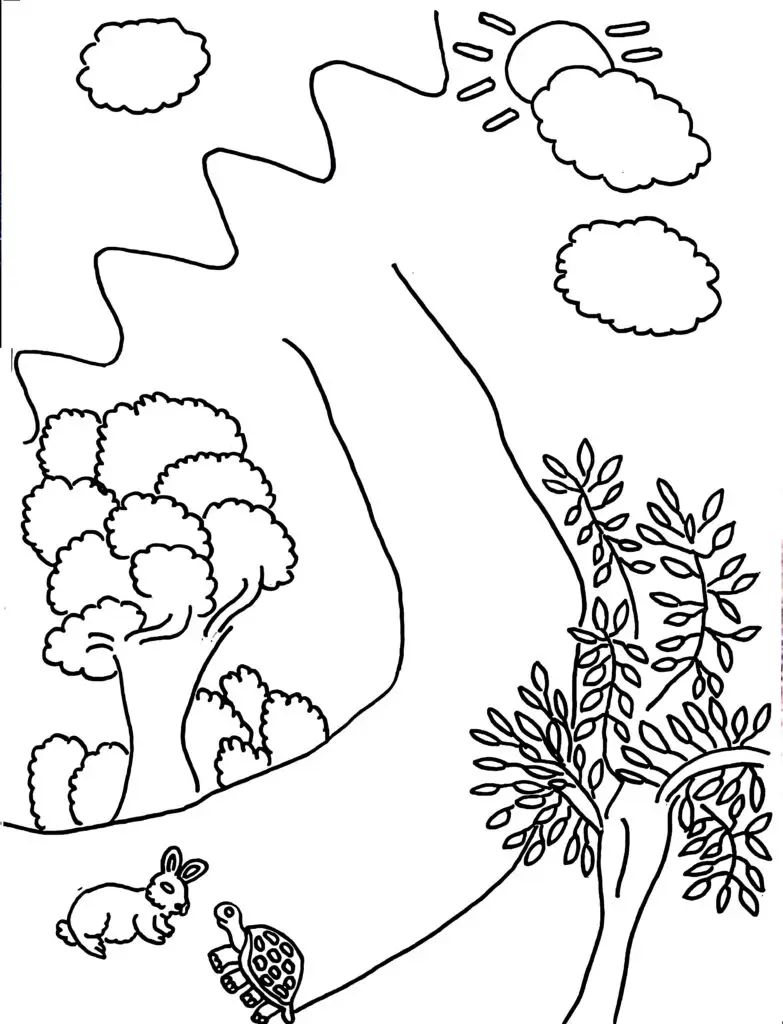
Black and white line art coloring page depicting the tortoise and the hare at the start of a winding path surrounded by trees, clouds, and a sunny sky.

Free printable coloring pages - Tortoise drawing

The story of the Tortoise and the Hare: History, Author and iconic Illustrator

The story of the Tortoise and the Hare: History, Author and iconic Illustrator

1. Do you know who was the author of "The Tortoise and the Hare" fable?

An ancient Greek storyteller named Aesop wrote the tale of the Tortoise and the Hare.

Aesop resided in Ancient Greece between 620 and 564 BCE.

Many versions of the original story have been created by different people all over the world.

2. Do you know about the Perry Index?

Aesop's stories are organized in the Perry Index.

The Perry index was created by professor Ben Edwin Perry (1892-1968) in his work Aesopica (1952).

He sorted stories by language (Greek, followed by Latin) and then by chronologically based on the earliest known source, and finally by alphabetical order.

3. Do you know about Eric Carle?

Eric Carle was famous for creating storybooks that featured not only a story as text but also interesting illustrations.

Eric Carle is among those who brought Aesop's fable to life.

In 1980, he released Twelve Tales from Aesop, which he both retold and illustrated.

Carle's retelling is characterized by his signature colorful collage-style artwork, which brought new visuals to these classic stories.

4. Do you know about Jean Grandville?

Jean Grandville was a French cartoonist and well known for his anthropomorphic drawings and cartoons.

He portrayed and drew animals that behaved, talked, and expressed emotions like humans.

In his adaptation of the story of "The Tortoise and the Hare," Grandville portrayed a tortoise walking and running on two legs.

5. Have you heard about Walt Disney's cartoon version of the story of "The Tortoise and the Hare"?

Walt Disney produced an animated short film based on the story of the tortoise and the hare for his Silly Symphonies series

6. What is the moral of The Tortoise and the Hare story?

The Tortoise and the hare teaches us the lesson that slow and steady work can lead to success.

It does not guarantee that fast or strong work leads to success.

References

  1. https://kids.britannica.com/scholars/article/Aesop/3883
  2. https://en.wikipedia.org/wiki/Aesop
  3. https://www.wikiwand.com/en/articles/Perry Index
  4. https://en.wikipedia.org/wiki/Perry Index
  5. https://en.wikipedia.org/wiki/Eric Carle
  6. https://kids.britannica.com/scholars/article/Eric-Carle/623300
  7. https://en.wikipedia.org/wiki/Perry Index

The story of the Tortoise and the Hare: History, Author and iconic Illustrator

Access the document directly online.

The story of the Tortoise and the Hare


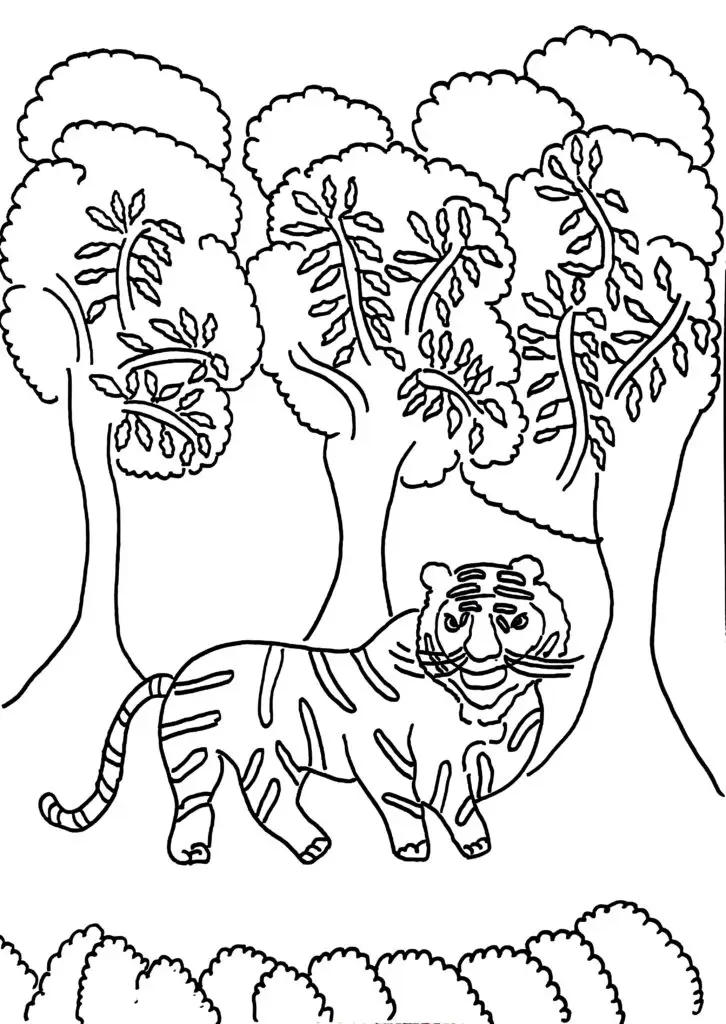
Black and white line art coloring page of a striped Siberian tiger walking through a dense forest surrounded by leafy tall trees.

Free printable coloring pages - Tiger drawing

Siberian Tiger Facts: Inside the Life of Earth’s Largest Cat

Siberian Tiger Facts: Inside the Life of Earth’s Largest Cat

1. What are the other names for the Siberian tiger?

The Siberian tiger is also known by various other names, including the Amur, the Manchurian, the Korean, and the Ussurian tigers.

The name Amur tiger comes from the Amur River region, where it is found.

The Manchurian comes from the Manchuria region of northeastern China.

Historically, they were also found on the Korean peninsula and also deeply rooted in Korean traditions as a symbol of power, strength and national identity, which is why they are known as Korean tigers.

They are also found near the Ussuri River in eastern Russia, hence the name Ussurian tigers.

2. Why is the Siberian tiger’s night vision stronger than that of humans?

The Siberian tigers have a greater number of rods in their eyes than humans.

The increased number of rods allows the Siberian tiger to detect the movement of its prey at night when color vision is ineffective.

The Siberian tigers have a structure called the tapetum lucidum present behind the retina, which helps them to view other animals in low-light conditions.

3. Which is the only species of tiger that survives in snow?

The Siberian tiger species has the ability to withstand extreme freezing temperatures.

They have adapted with a thicker, longer fur coat and additional fat layers to fight against the cold.

Their fur coat becomes longer and thicker, and their paws develop a thick fur pad, called winter boots, which keep them alive in cold temperatures.

4. Do you know the unique characteristics of the Siberian tiger?

They are distinguished by a thick, pale-yellow coat and narrow black stripes.

The weight of an adult male tiger ranges between 200 and 400 kg, while that of a female is between 120 and 180 kg.

The male tiger's head-to-body length ranges between 180 and 200 cm, while that of a female is between 160 and 184 cm.

5. Do you know the lifespan of the Siberian tiger?

They generally have a lifespan between 12 and 15 years in the wild. When kept under human care, they can live up to 25 years.

References

  1. https://www.britannica.com/animal/Siberian-tiger
  2. https://en.wikipedia.org/wiki/Siberian_tiger

Siberian Tiger Facts: Inside the Life of Earth’s Largest Cat

Access the document directly online.

Siberian Tiger Facts: Inside the Life of Earth’s Largest Cat


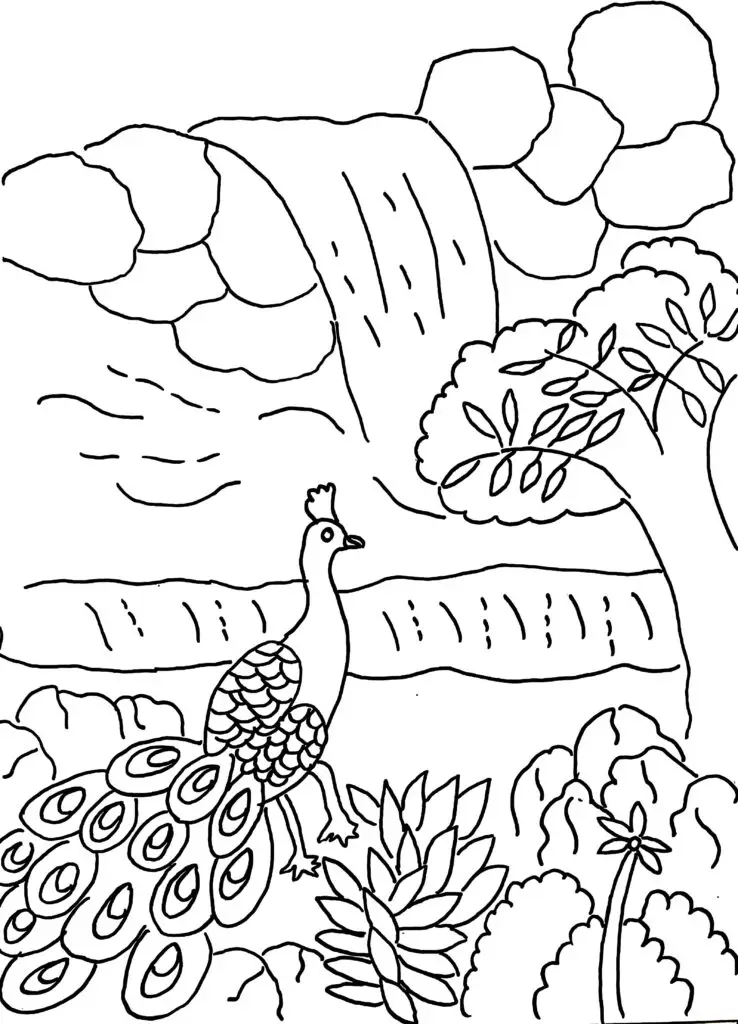
Black and white line art coloring page showing a detailed peacock with open tail feathers standing near a flowing waterfall, trees, and lush plants.

Free printable coloring pages - peacock drawing


Green Peafowl: Historical Significance, Subspecies Classifications, and Distinctive Characteristics

Green Peafowl: Historical Significance, Subspecies Classifications, and Distinctive Characteristics

1. How many subspecies of green peafowl are there?

There are three known subspecies of green peafowl: a) Java Peafowl, b) Indo-Chinese peafowl, and c) Burmese Peafowl.

a) Java Peafowl (Pavo muticus muticus): Males have green and golden feathers on the neck, chest, and back, with eye-like spots, called ocelli, on their long feathers. Females have reddish-brown feathers on their backs and wings. Both sexes have a fan-shaped crown of feathers on their head. They are native to the island of Java and other parts of Indonesia.

b) Indo-Chinese Peafowl (Pavo muticus imperator): They are native to Southeast Asia, including China, Myanmar, Thailand, Laos, Cambodia, and Vietnam, and have muted green-bronze feathers on their body, neck, and wings.

c) Burmese Peafowl (Pavo muticus spicifer): Their crest and neck are green colored, and are dullest among the three subspecies. They are native to northwestern Burma, parts of India, and Bangladesh.

2. What is the historical significance of green peafowl?

In ancient Burma, the green peafowl was a symbol of the monarchs.

The green peacock was on the flag of the governor at the time of British rule in Burma.

It was also on the flag of the state of Burma, from 1943-1945.

It was the coat of arms of Myanmar’s last kingdom, called the Konbaung kingdom.

For a long time, it was illustrated in Japanese painting.

3. Do you know about the diet of green peafowl?

They are omnivorous and eat plant-based matter such as fruits, flower buds, and berries as well as animals such as invertebrates, reptiles, frogs, and venomous snakes.

4. Who coined the name Pavo muticus?

The name was coined by the Swedish naturalist Carl Linnaeus in 1766.

5. What are the unique characteristics of green peafowl?

Green peafowl are the longest of all wild flying birds. A male’s head-to-body length varies between 1.6 and 3.2 m, whereas a female’s measures between 1 and 1.4 m.

The train length in males ranges between 1.3 and 1.8 m, while females lack a train.

The males produce the distinct “ki-wao” call, whereas females produce an “aow-aa” sound.

References

  1. https://en.wikipedia.org/wiki/Green_peafowl

Green Peafowl: Historical Significance, Subspecies Classifications, and Distinctive Characteristics

Access the document directly online.

Green Peafowl: Historical Significance, Subspecies Classifications, and Distinctive Characteristics
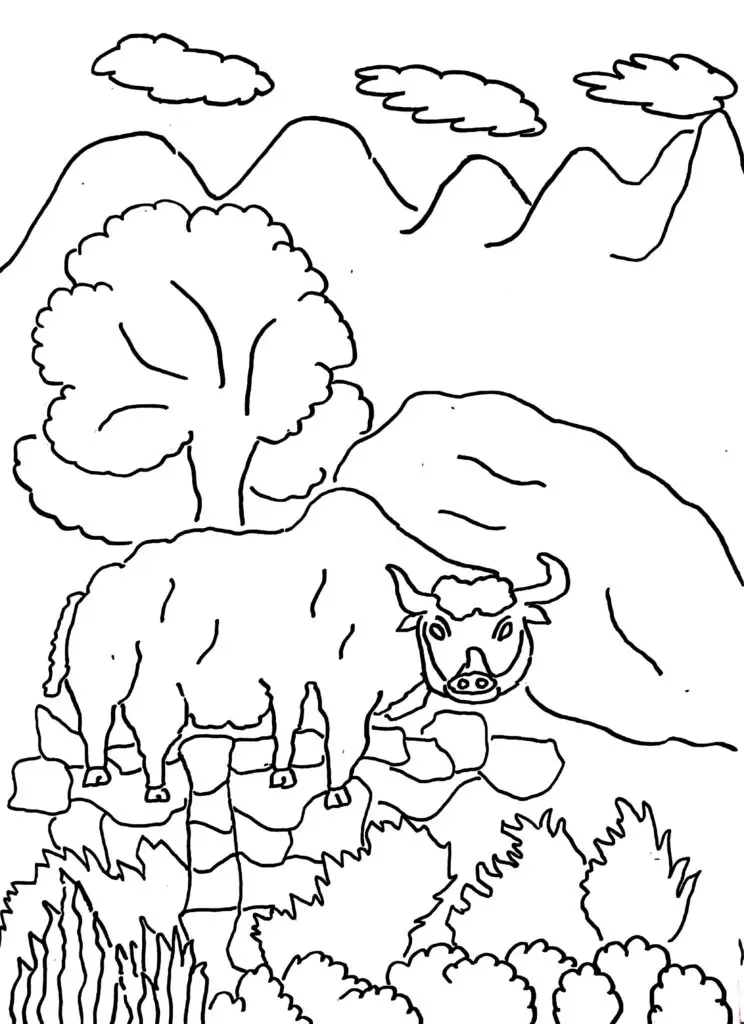
Black and white line art coloring page depicting a long-haired yak standing in front of trees and scenic mountain peaks under a cloudy sky.

free printable coloring pages - Yak

Yak Wonders of the High Altitudes: Unique Traits, Swift Speeds, and the Legacy of Himalayan Milk and Butter Products

Yak Wonders of the High Altitudes: Unique Traits, Swift Speeds, and the Legacy of Himalayan Milk and Butter Products

1. What is the use of yak butter?

Yak butter has various applications, including the preparation of food and beverages, cultural and religious products as well as the manufacturing of cosmetics products.

It is utilized to make yak butter tea, which is made by churning yak butter, brick tea, and salt. Tsampa is a dish in which butter is mixed with roasted barley flour to create dough.

Yak butter is also used in the making of sculptures of animals, landscapes, and as fuel to light butter lamps in the traditional festivals. . It is one of the ingredients of cosmetic creams and acts as a moisturizer.

2. What do you mean by yak alcohol?

Yak mil-based alcoholic beverages are traditional preparations that involve the fermentation of yak milk by using lactic acid bacteria and yeast.

During this process, lactose is converted into lactic acid, and a small quantity of ethanol is produced.

Milk wine, kurut, and Shimiin are examples of such products.

3. Why does Yak milk appear pink?

When a baby yak is born, the mother’s first milk has some amount of blood, and this blood imparts a pink color to the milk.

This milk is called colostrum and is rich in protein.

The color change is temporary, and milk returns to its normal white color after some time.

4. How fast can Yaks run?

Yaks can run at a speed of 25 mph.

In some regions that are situated at high altitudes, such as Tibet, Mongolia, Kazakhstan, and Ladakh, domesticated yak racing takes place during the traditional festivals.

5. What is distinctive about yak?

A yak’s body is covered with a thick, hairy coat, which plays a role in insulation for cold environments.

They have a higher lung capacity than cattle.

A yak’s lungs are supported by 14–15 pairs of ribs when compared to cattle, which have only 13 pairs of ribs.

They also possess a large chest cavity, which supports breathing at high altitude.

They have a greater number of red blood cells and a larger heart compared to cattle.

A yak’s hemoglobin shows higher affinity for oxygen, and its anatomy is such that it can rapidly intake a large quantity of oxygen.

References

  1. https://en.wikipedia.org/wiki/Yak
  2. https://www.britannica.com/animal/yak
  3. https://en.wikipedia.org/wiki/Yak_butter

Yak Wonders of the High Altitudes: Unique Traits, Swift Speeds, and the Legacy of Himalayan Milk and Butter Products

Access the document directly online.

Yak Wonders of the High Altitudes
collection of animal coloring pages
If you are looking for wildlife or domestic animal coloring pages, visit [Animal Colouring Pages] to explore and download our collection
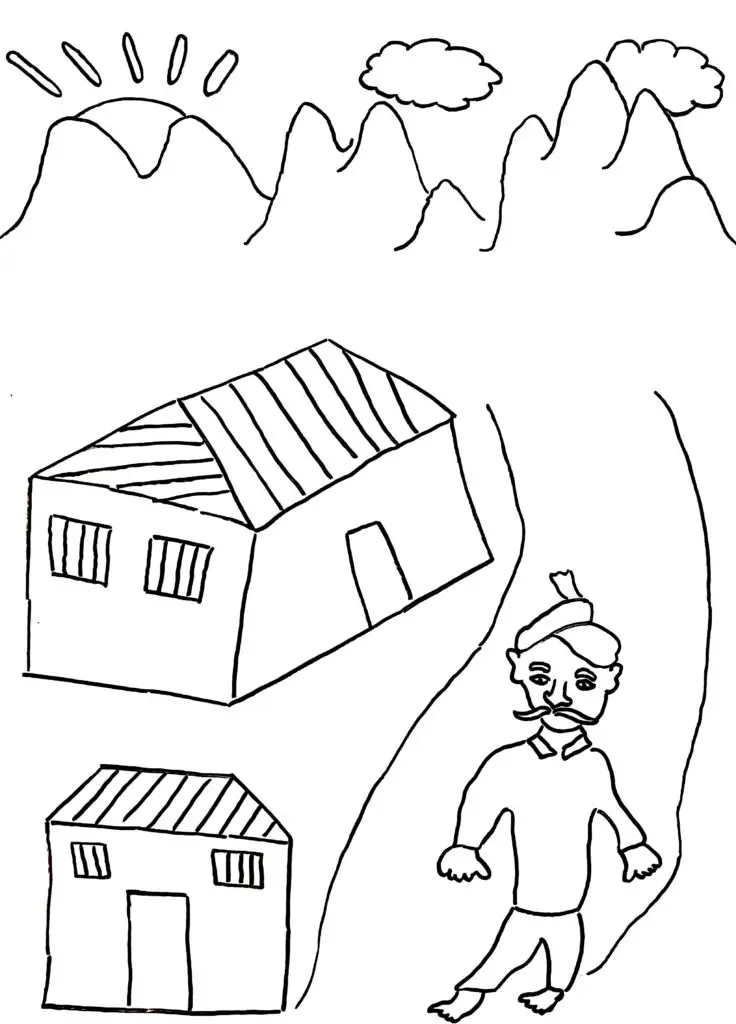
Black and white line art coloring page showing a village man wearing a turban on a path near rural houses, with mountains and a rising sun in the background.

Free printable coloring pages- Village drawing

Mountains of extreme: Earth's highest. longest, oldest, farthest, and smallest peaks

Mountains of extreme: Earth's highest. longest, oldest, farthest, and smallest peaks

1. What is the name of the world's highest mountain above sea level?

Mount Everest, situated in the Mahalangur Himal region of the Himalayas, is the highest mountain.

It measures about 29,032 feet (8,848.86 meters) in height.

It is also known by the names Sagarmatha (Nepali) and Chomolungma (Tibetan).

2. What is the name of the longest mountain range in the world above sea level?

The Andes Mountain range, which is situated on the western coast of South America, is the longest mountain range in the world.

It measures a length of about 8900 km (5530 miles).

It covers several countries, including Colombia, Venezuela, Peru, Bolivia, Chile, Argentina, and Ecuador.

3. Which is the oldest mountain range in the world?

The Barberton Makhonjwa Mountains, situated in South Africa and Eswatini, are the oldest in the world, having formed about 3.6 billion years ago.

This mountain ranges is on the UNESCO's World Heritage Site list.

4. Which is the farthest mountain from the center of the earth?

Mount Chimborazo, situated in central Ecuador within the Andes Mountains, measures about 20,548 feet (6,263 meters) in height above sea level.

It is considered the farthest point from the center of the Earth.

5. Which is the world's smallest mountain above sea level?

Mount Wycheproof, situated in Victoria, Australia is the smallest mountain in the world above sea level.

It measures about 482 feet (147 meters) in height.

References

  1. https://en.wikipedia.org/wiki/Mount_Everest
  2. https://www.britannica.com/place/Mount-Everest
  3. https://www.britannica.com/place/Andes-Mountains
  4. https://en.wikipedia.org/wiki/Andes
  5. https://www.britannica.com/place/Chimborazo-mountain-Ecuador
  6. https://en.wikipedia.org/wiki/Chimborazo
  7. https://www.ndtv.com/travel/barberton-greenstone-belt-a-3-6-billion-year-oldunesco-world-heritage-site-9663278
  8. https://whc.unesco.org/en/list/1575/
  9. https://en.wikipedia.org/wiki/Mount_Wycheproof

Mountains of extreme: Earth's highest. longest, oldest, farthest, and smallest peaks

Access the document directly online.

Mountains of extreme: Earth's highest. longest, oldest, farthest, and smallest peaks
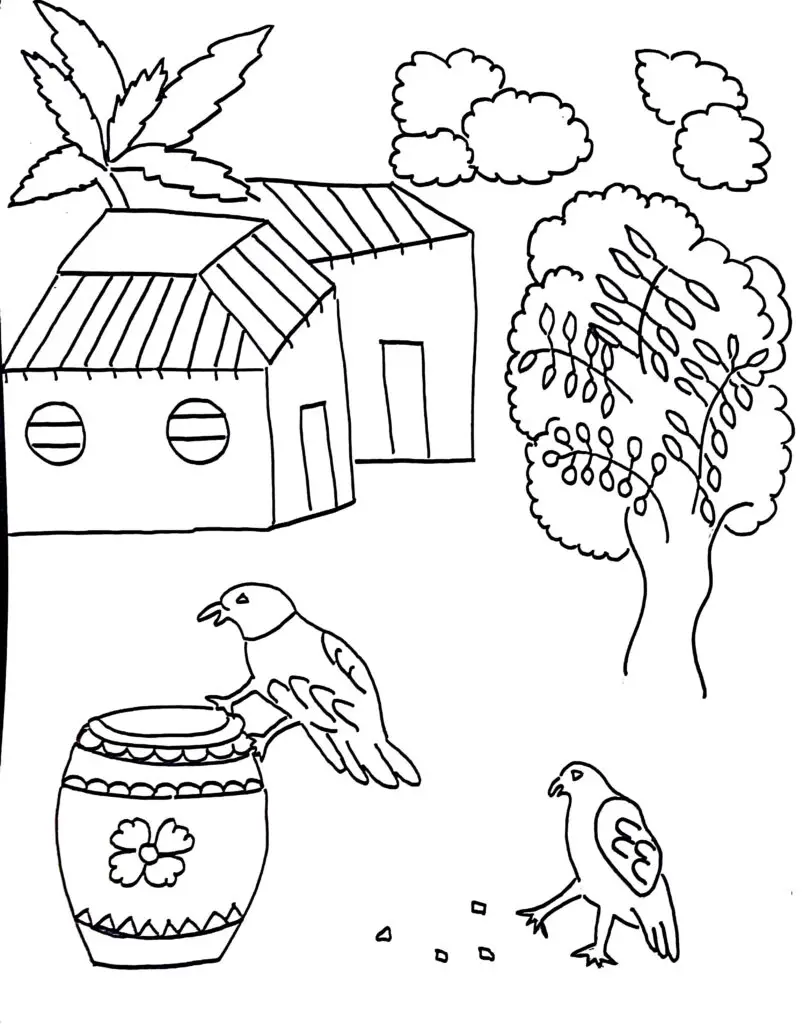
Black and white line art coloring page illustrating Aesop's fable The Thirsty Crow, featuring a crow perched on a pot of water next to another bird picking up pebbles, with village houses and trees in the background.

Free printable coloring pages - Crow drawing

The Crow and the Pitcher

The Crow and the Pitcher

1. Are there modern adaptations of the fable “The Thirsty Crow”?

There various modern adaptations of the fable ‘The Thirsty Crow.

Some of these are mentioned here.

Emma Carlson Berne created a song or rhyme version of the famous fable titled The Crow and the Pitcher, published in 2018.

In another version, The Thirsty Crow Reimagined (2025), the author provides a new perspective along with bold, contemporary illustrations for young readers.

The Smart Crow Never Goes Thirsty (2008): A Manager’s Toolkit for Creativity and Innovation give a creative and innovative tool based on the story where a smarter crow uses a straw instead of collecting pebbles.

The Thirsty Crow, written by Mugdha Sakpal and published in 2025, is another book based on the famous fable that used Gond art, a traditional Indian art style, for illustration.

Lee Jenkins’ version, titled The Thirsty Crow: Aesop’s Little by Little fable (2022), is an illustrated and easy-language book mainly created for kids aged 4 to 7.

2.What is number of the famous story The Thirsty Crow in Perry index?

The Thirsty Crow also called The Crow and the Pitcher, is story number 390 in the Perry index.

3. What is the lesson of the story ‘The Thirsty Crow’?

“The Thirsty Crow” story teaches us that if one wishes to complete a work, one will find the solution to complete that work.

It also teaches the lesson that slow, steady, intelligent, and smart work ensures a solution to an impossible problem, despite if one has very few resources to solve the problem.

4. Are there historical adaptations of Aesop’s famous story, “The Thirsty Crow”?

There are various historical adaptations of the story ‘The Thirsty Crow’ story.

Some of these are mentioned here.

Bianor, a poet from Ancient Greece, created a poetic version of the story in the first century CE.

Avianus’s compilation of Latin poems from the 4th and 5th centuries also features a poetic version of the story.

It was also part of an Indian storybook known as the Panchatantra, attributed to Pandit Vishnu Sharma, which was compiled between 300 BCE and 200 BCE.

References

  1. https://en.wikipedia.org/wiki/The_Crow_and_the_Pitcher
  2. https://en.wikipedia.org/wiki/Perry_Index
  3. https://www.artsindia.com/blogs/news/what-is-gond-art
  4. https://en.wikipedia.org/wiki/Bianor_(poet)

The Crow and the Pitcher

Access the document directly online.

The Crow and the Pitcher
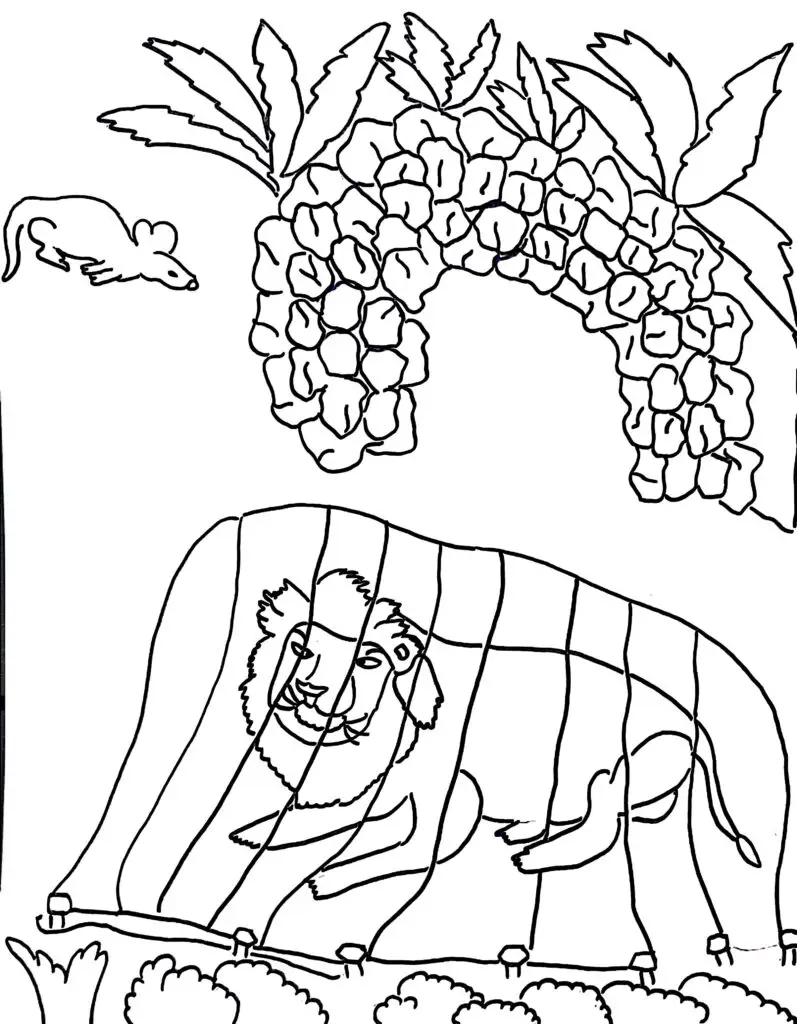
Black and white line art coloring page based on Aesop's fable The Lion and the Mouse, showing a lion trapped under a net with a small mouse approaching from above under jungle trees.

Free printable coloring pages - lion drawing

The Lion and the Mouse

The Lion and the Mouse

1. What lesson does Aesop’s fable The Lion and the Mouse teach?

Aesop’s famous fable, The Lion and the Mouse, teaches us a lesson that goodwill is never wasted, and even a little and weak person can manage to help the strong and big one whenever a situation arises.

It is number 150 in the Perry index.

2. Did you know that the story of The Lion and the Mouse has appeared on a postage stamp?

Yes, the famous fable The Lion and the Mouse has been featured on the postage stamps of different countries, including Zambia, Greece and Hungary.

In 1987, Greece issued a stamp based on Aesop’s fables that included The Lion and the Mouse.

The same year, Hungary also issued a fairy tale stamp featuring the fable.

In 1990, Zambia issued a stamp based on folk tales, featuring the story of The Lion and the Mouse.

3. Are there ancient adaptations of Aesop’s famous story The Lion and the Mouse?

Yes, there are distinct adaptations of the famous story, “The Lion and the Mouse.”

Below are several examples.

The story is featured in ancient Indian storybooks, such as the Panchatantra and Jataka tales.

In ancient Egypt, the story has some distinct adaptations, in which humans capture the lion, and the mouse manages to save its life.

In a Russian version, the mouse demands permission to build a house near the lion’s cave, but the lions do not accept the demand.

When a lion is confined by a hunter and saved by the mouse, then and only then does the lion accept the mouse’s demand.

4. Have you heard about the Jerry Pinkney version of the fable “The Lion and the Mouse”?

Jerry Pinkney created the wordless picture book based on the story.

This book adaptation is set in the Serengeti National Park in Tanzania.

For the beautiful illustrations made in the book, he won the Caldecott Medal in 2010.

References

  1. https://en.wikipedia.org/wiki/The_Lion_and_the_Mouse
  2. https://kids.britannica.com/kids/article/Jerry-Pinkney/627866
  3. https://www.britannica.com/art/Caldecott-Medal

The Lion and the Mouse

Access the document directly online.

The Lion and the Mouse
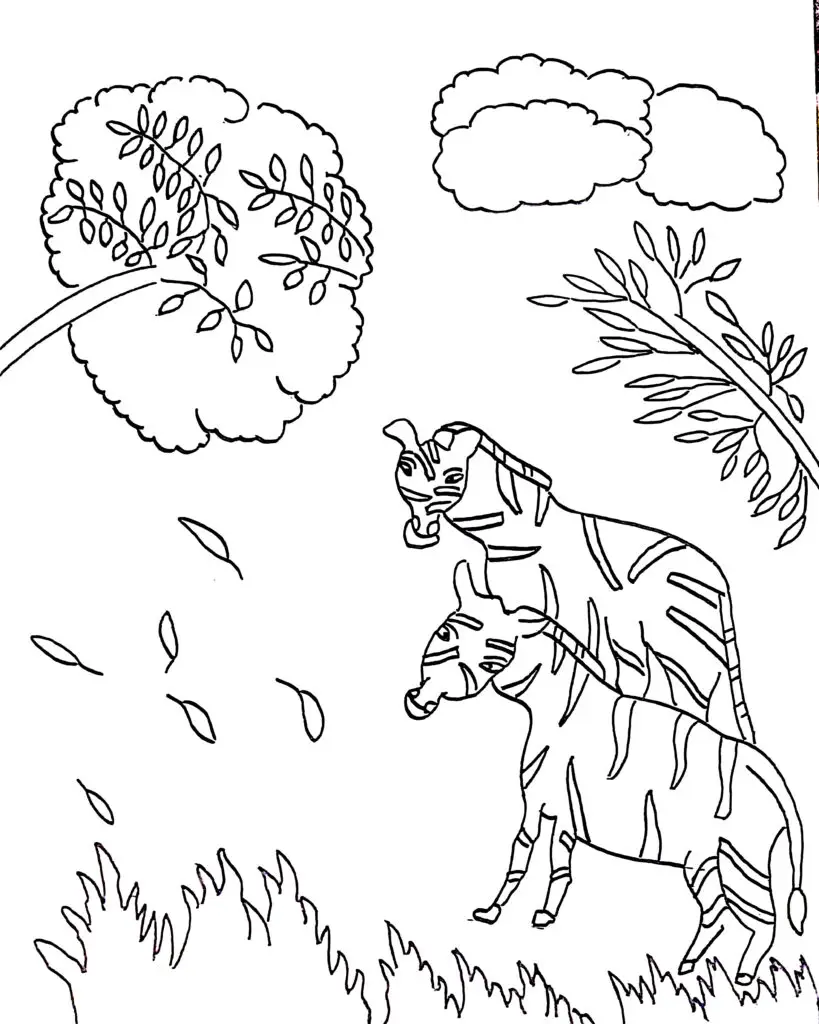
Black and white line art coloring page depicting two striped zebras standing in a grassland with leafy trees, falling leaves, and clouds in the sky.

Free printable coloring pages - Zebras drawing

Facts About Zebras: Exploring Each Species of Zebra and Botswana’s Iconic National Animal

Facts About Zebras: Exploring Each Species of Zebra and Botswana’s Iconic National Animal

1. Do you know how many living species of zebra there are?

There are three living species of zebra.

a) Grevy’s zebra

b) Plains zebra

c) Mountain zebra


a) Grevy’s zebra:

It is the largest of all wild members of the Equidae family and is native to Kenya and Ethiopia.

It has distinctive characteristics that include long legs, long and rounded ears, narrow and closely placed stripes, a long neck, , a large head, and an erect mane.

It has an average life span of about 20 to 25 years.

Its overall appearance resembles that of a mule or donkey.

The average head-body length varies from 2.50 to 2.75 m, and its average weight is about 350 to 450 kg.

It is found in semi-arid grassland and scrubland areas.

Grevy’s zebra can manage to survive without drinking water for about 5 days.


b) Plains zebra:

They have broad black and white stripes as compared to the Grevy’s zebra species, with a short and erect mane.

Their weight varies from 220 to 330 kg, and their length varies from 217 to 246 cm.

They have short legs, a concave nose, a convex forehead, tufted hair, and an erect mane and are the most widespread of the three zebra species.

They are found in southern and eastern Africa.

There are about seven subspecies of the plains zebra. These are the i) Maneless zebra, ii) Grant’s zebra, iii) Crawshay’s zebra, iv) Chapman’s zebra, v) Burchell’s zebra, vi) Quagga, and vii) Selous’ zebra.

They are found in grassland as well as mountains, at altitudes up to 14000 feet.


c) Mountain zebra:

They have very bold black or dark brown colored stripes on their body.

Their average length varies from 2.1 to 2.6 m, and their weight varies from 210 to 375 kg.

They lack stripes on their bellies.

They are mainly found in southwestern Africa.

There are two subspecies of mountain zebra.

These are the Cape mountain zebra and Hartmann’s mountain zebra.

They have grid-like stripes on their rump and tough hooves.

Their tough hooves help them to climb mountains.

They are found in mountain areas of about 6500 feet above the ground.

2. Which country has the zebra as its national animal?

Zebra is the national animal of Botswana and appears on its coat of arms.

it represents robustness, harmony, and a rich wildlife heritage.

3. Are zebras white- or black-colored animals?

They are black-colored animals with white stripes on them.

References

  1. https://en.wikipedia.org/wiki/Gr%C3%A9vy%27s_zebra
  2. https://en.wikipedia.org/wiki/Plains_zebra
  3. https://en.wikipedia.org/wiki/Mountain_zebra
  4. https://en.wikipedia.org/wiki/Coat_of_arms_of_Botswana

Facts About Zebras: Exploring Each Species of Zebra and Botswana’s Iconic National Animal

Access the document directly online.

Facts About Zebras: Exploring Each Species of Zebra and Botswana’s Iconic National Animal
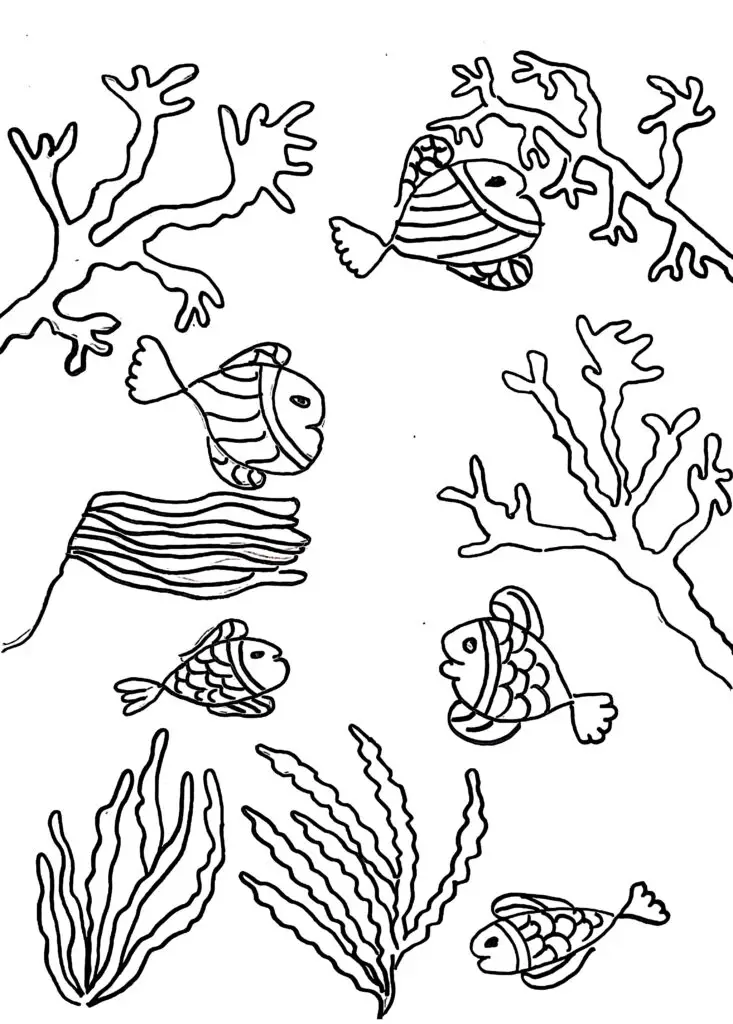
lack and white line art coloring page depicting an underwater ocean scene with small swimming fish, coral reefs, and wavy seaweed plants.

Free printable coloring pages - fish drawing

The Ocean’s Forest: Seaweed Types, Lifespan, and Unique Features

The Ocean’s Forest: Seaweed Types, Lifespan, and Unique Features

1. Is seaweed a plant?

Seaweeds are not plants. Seaweeds are also called macroalgae, which include thousands of species.

2. What are the characteristics of seaweed?

These are classified into three groups: a) Rhodophyta, b) Chlorophyta, and c) Phaeophyta.

The entire body is known as thallus, which consists of various structures such as holdfast, stipe, lamina, and pneumatocyst.

The holdfast helps attach the seaweed to objects like rocks.

The lamina plays a role in photosynthesis.

A stipe is a stem-like structure that helps support the lamina.

A pneumatocyst is an air-filled bladder that helps them float on the water’s surface.

Their size varies according to species, habitat, and structure.

They can absorb nutrients and water from their surrounding environments.

A habitat that is enriched with nutrients supports high growth of seaweeds.

3. What are the unique properties of seaweed?

There are some unique features of seaweed that distinguish it from terrestrial plants.

It has incredibly fast growth and can develop without requirements such as freshwater, fertilizer, and pesticides that are essential for terrestrial plants to thrive properly.

Although they look like plants, they are not true plants. Seaweed creates forests for underwater life.

4. What is the lifespan of seaweed?

The lifespan of seaweed varies by species and is influenced by environmental factors such as nutrients, location, and light.

Generally, many species have a lifespan of about 7 to 15 years.

Species such as Sargassum can live for 3 to 4 years, while coralline algae can live for decades.

References

  1. https://www.britannica.com/science/seaweed
  2. https://en.wikipedia.org/wiki/Seaweed
  3. https://www.americanscientist.org/article/the-science-of-seaweeds
  4. https://kids.britannica.com/scholars/article/seaweed/66498

The Ocean’s Forest: Seaweed Types, Lifespan, and Unique Features

Access the document directly online.

The Ocean’s Forest: Seaweed Types, Lifespan, and Unique Features
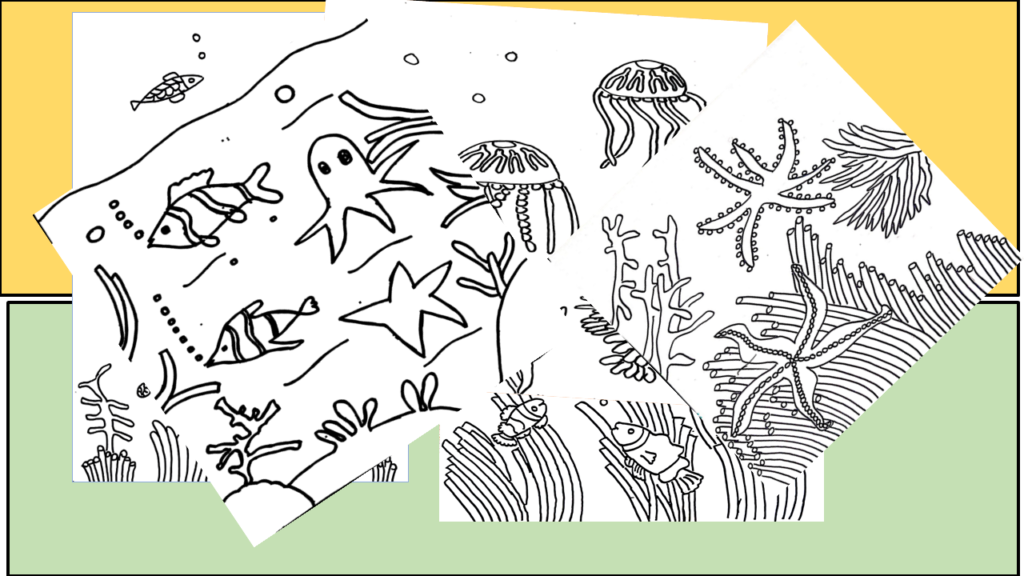
If you are looking for sea animal coloring pages, visit (sea animal coloring pages) to explore and download our collection
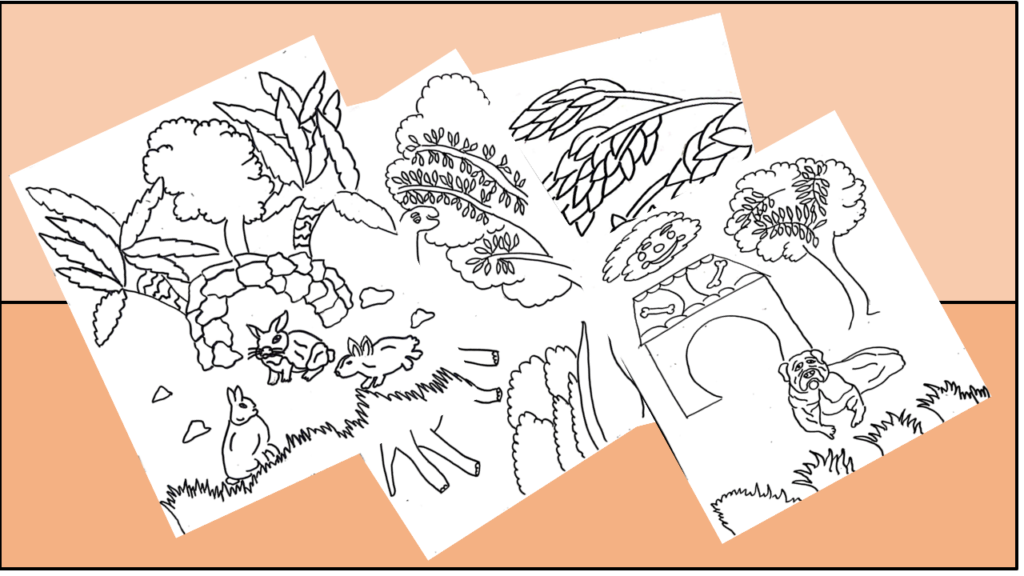
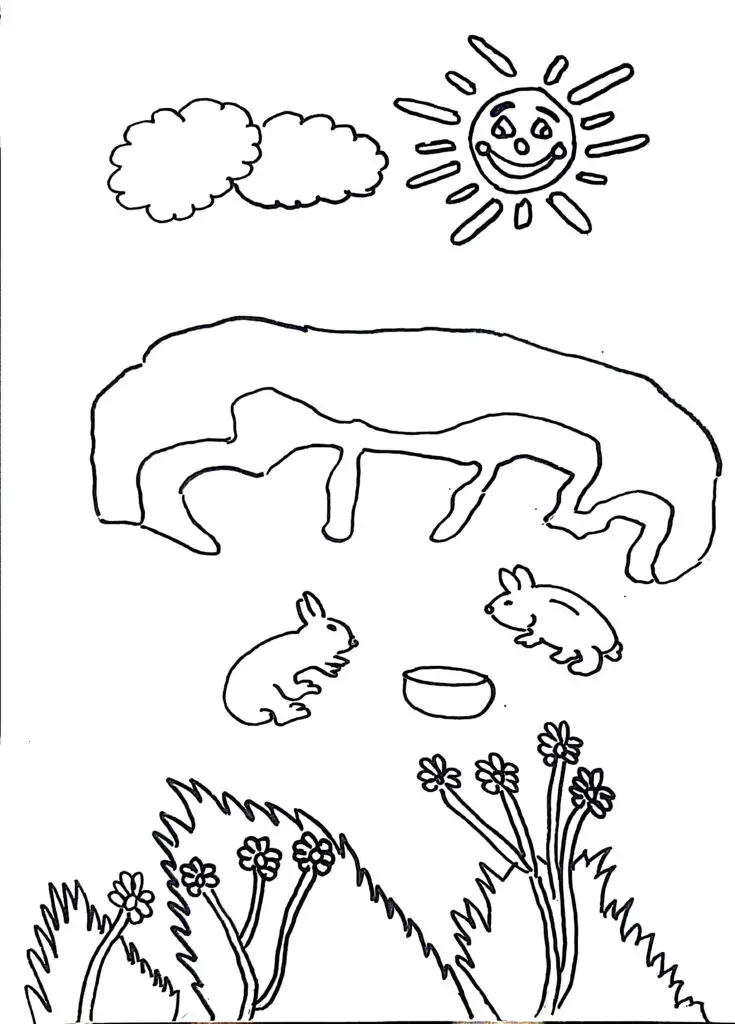
Black and white line art coloring page depicting two cute rabbits next to a bowl in a grassy garden with flowers, clouds, and a smiling sun in the sky.

Free printable coloring pages -Rabbit drawing

Rabbit Facts: From the Largest to Smallest Breeds, Top Speed, and Names for Male, Female, and Baby Rabbits

Rabbit Facts: From the Largest to Smallest Breeds, Top Speed, and Names for Male, Female, and Baby Rabbits

1. Which is the largest breed of rabbit?

The Flemish Giant rabbit is considered the largest among domestic rabbits and is also called the “Gentle Giant” or the “King of Rabbits”.

Its weight varies between 15 and 25 pounds, and its length measures between 2.5 and 4 feet.

It has a tractable, quiet, and friendly nature and is native to Belgium.

It has a long body, strong legs, a glossy coat, and big ears and is available in black, blue, fawn, sandy, white, or grey.

2. Which is the smallest rabbit?

Among all rabbits, the pygmy rabbit (Brachylagus idahoensis) is considered the smallest.

The pygmy rabbit normally weighs less than a pound and is found in North America.

It has small ears, tiny legs, and greyish-brown fur.

Its average weight ranges between 0.8 and 1.1 pounds, and its size varies from 9 to 12 inches.

3. At what speed can a rabbit run?

They are able to run at a speed of about 25 to 45 mph.

Domestic rabbits can reach up to a speed of 25 mph, while wild rabbits such as jackrabbits are able to run at a speed of 45 mph.

4. Do you know that male, female, and baby rabbits are known by different names?

Among rabbits, males are called bucks, females are called does, and baby rabbits are called kits.

References

  1. https://en.wikipedia.org/wiki/Flemish_Giant_rabbit
  2. https://animals.howstuffworks.com/pets/otherpets/flemish-giant-rabbit.htm
  3. https://simple.wikipedia.org/wiki/Flemish_Giant_rabbit
  4. https://en.wikipedia.org/wiki/Pygmy_rabbit
  5. https://www.britannica.com/animal/rabbit#ref800369

Rabbit Facts: From the Largest to Smallest Breeds, Top Speed, and Names for Male, Female, and Baby Rabbits

Access the document directly online.

Rabbit Facts
Airplane History: The Pioneers, Breakthroughs, and Moments That Changed Flight

Airplane History: The Pioneers, Breakthroughs, and Moments That Changed Flight

1. How can one define a plane?

A plane is a machine that can fly through the air with the help of one or more engines and also has fixed wings.

2. Who is credited with the concept of modern airplanes?

An English engineer, Sir George Cayley, is credited with the concept of the airplane, as he first conceptualized the modern airplane’s configuration and components.

3. Who is known as the pioneer of flight?

Orville and Wilbur Wright are recognized as pioneers of flight who successfully conducted the powered airplane flight on December 17, 1903, near Kitty Hawk, North Carolina.

4. Who is credited with the development of steam-powered aircraft?

Samuel Langley is credited with the development of steam-powered aircraft.

5. What is the difference between the terms “aircraft” and “airplane”?

“Aircraft” is a term commonly used for drones, helicopters, balloons, and planes. In contrast, the term “airplane” is utilized only for aircraft that have fixed wings and one or more engines.

6. Who is the father of Indian civil aviation?

J.R.D. Tata is well-known as the father of Indian civil aviation and was also the first licensed pilot in India.

7. Who is the first licensed woman pilot in India to fly an aircraft?

Sarla Thakral is known as the first Indian woman to obtain her pilot’s license and fly an aircraft in 1936 at the age of 21.

References

  1. https://en.wikipedia.org/wiki/Airplane
  2. https://en.wikipedia.org/wiki/George_Cayley
  3. https://en.wikipedia.org/wiki/Wright_brothers
  4. https://en.wikipedia.org/wiki/Samuel_Langley
  5. https://en.wikipedia.org/wiki/JRD_Tata
  6. https://en.wikipedia.org/wiki/Sarla_Thukral

Airplane History: The Pioneers, Breakthroughs, and Moments That Changed Flight

Access the document directly online.

Scroll to Top