



Nature coloring pages offer a wonderful way for kids and adults to connect with the natural world through creativity. These pages feature scenes of forests, animals, flowers, fruits, and vegetables that inspire relaxation and learning. Nature inspires. Nature heals. Nature teaches. In addition to being enjoyable, coloring these pages can help improve focus and fine motor skills. Moreover, they are great tools for environmental and nutritional education, subtly encouraging appreciation for wildlife, plants, and healthy food choices. As a result, users often feel more connected to the world around them. While some designs are complex and detailed, others are simple and beginner-friendly. Created by artists with a love for the outdoors and gardening, many of these illustrations reflect real ecosystems and edible plants. Furthermore, they provide a screen-free, peaceful activity suitable for all ages. They are loved by teachers, parents, and therapists alike. Ultimately, nature coloring pages promote mindfulness and a deeper respect for our planet.
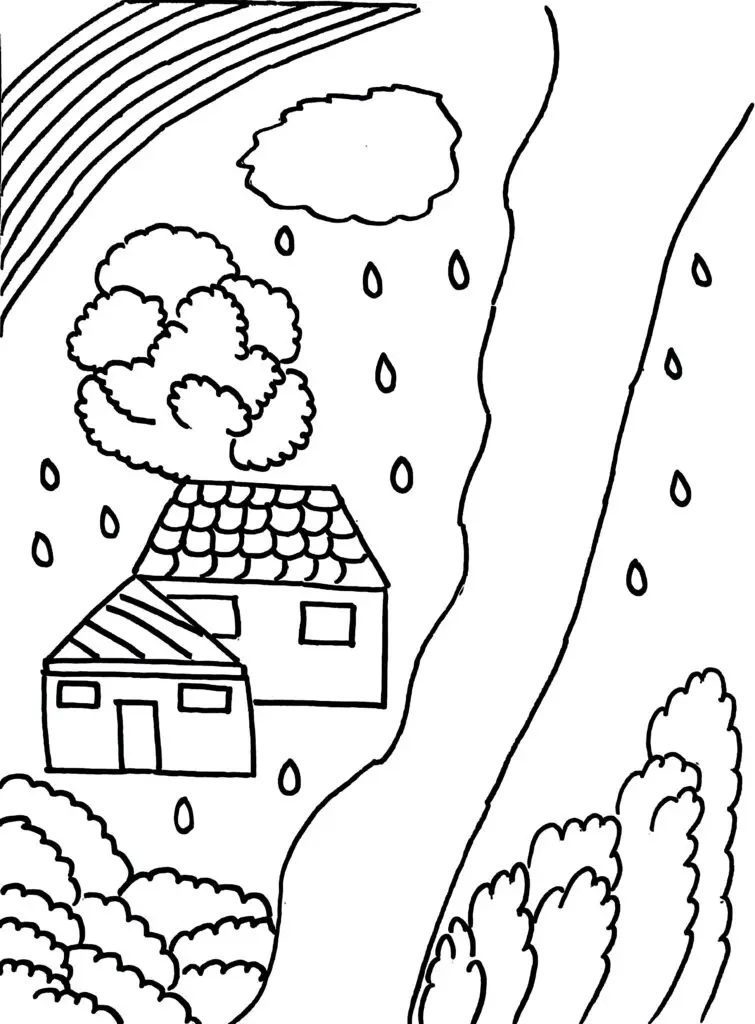
Nature coloring pages- A rainbow in the sky
Rainbow
Do you know what a rainbow is?
The phenomenon where one can see a colorful arc as a result of refraction and reflection of sunlight through rainwater droplets, is called a rainbow. It is a full circular-shaped natural phenomenon, but from the ground it looks like only an arc. The complete circle can be seen at high altitudes, such as from an airplane.
2. Why are there seven colors in the rainbow?
The rainbow consists of seven different colors. These seven colors are consequences of different wavelengths of light that are separated when sunlight passes through a water droplet, that is a rainwater droplet. The colors encompassed are red, orange, yellow, green, blue, indigo and violet.
3. Do you know about the moonbow?
In a moonbow, there is refraction of moonlight through rainwater drops. It is an uncommon lunar phenomenon where a white or faint-colored arc appears. A person can see a moonbow in a region of waterfalls, as there is a presence of mist or water droplets. Moonbows can also appear in regions where there is clean and pollution-free air. Cumberland Falls in Kentucky, Victoria Falls, and Hawaii are examples of such places where we can see moonbows. It is seen only if there is a full moon.
4. Do you know in which part of the sky rainbows appear?
A rainbow is visible or seen in the reverse direction to that of the sun.
5. Do you know if an individual can see two rainbows at the same time?
The phenomenon is visible in the sky when there is double light reflection from raindrops. In this phenomenon, another rainbow with a faint and reverse color is visible outside the primary rainbow.
References
https://en.wikipedia.org/wiki/Rainbow
https://science.howstuffworks.com/nature/climate-weather/atmospheric/10-rainbow-myths.htm
https://kids.britannica.com/scholars/article/rainbow/62494
https://www.britannica.com/science/light/Reflection-and-refraction
https://www.britannica.com/science/reflection-physics
https://en.wikipedia.org/wiki/Light
https://www.britannica.com/science/wavelength
https://science.nasa.gov/ems/09_visiblelight/
https://kids.britannica.com/scholars/article/waterfall/76251
To download PDF click here- Rainbow
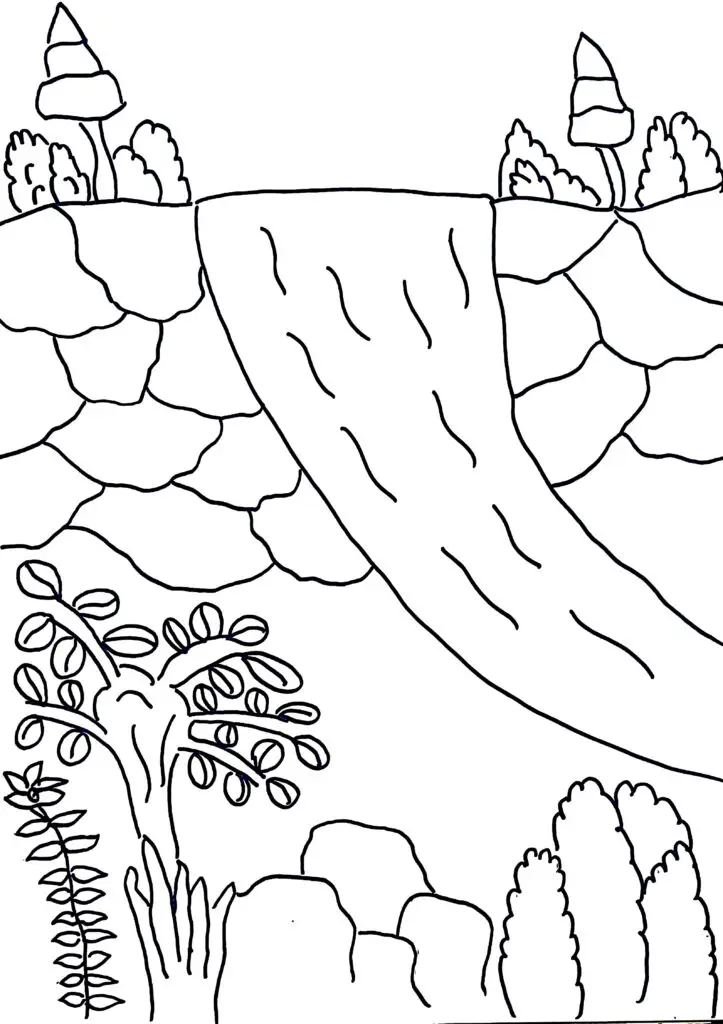
nature coloring pages- waterfall
Waterfalls
How many types of waterfalls are there?
Waterfalls are categorized depending on the height of fall, the way in which water comes down, the volume of water, and the width of the waterfall basin into different types.
These are as follows
a) Cataracts waterfalls —
Cataracts waterfalls are large and powerful waterfalls. There is a very high volume of water coming down. As the water comes down, it creates noise. Victoria Falls and Niagara Falls are examples of cataract waterfalls.
b) Cascade waterfalls –
There is tumbling water flow in the cascade waterfalls. The rock present in the path of water causes a hurdle to water flow. Here, water flows very slowly and in multiple small and consecutive drops. Roaring Fork Falls in North Carolina, Khon Waterfall in Thailand, and Barnafossar Falls in Iceland are some examples of cascade waterfalls.
c) Plunge pool waterfalls —
Water moves down vertically from a high point, losing contact with the rock surface. It is formed due to the impact of water, which has sand and pebbles in it. Such water causes erosion of soft rock and creates deep depressions, which are also called plunge pools or plunge basins. Nohkalikai Falls in Meghalaya, India, Caracol Falls in Brazil, and the Hannoki Falls in Japan are some examples of plunge pool waterfalls.
d) Horsetail waterfalls –
Water is always in contact with rock in its path. Rocks present in the path of water create a thin stream of water that looks like a horsetail. Waterfalls on El Capitan, located in Yosemite, California; waterfalls in Valdez, Alaska; and waterfalls in Queenstown, Tasmania, are examples of horsetail waterfalls.
e) Block waterfalls –
In this type, water falls from a broad river stream; and during falling, the waterfall looks like a rectangular shape. Niagara River Falls in the United States, is an example.
f) Chute waterfalls –
There is a very small and limited vertical passage, from where a large volume of water falls under high pressure. Three Chutes Falls in Yosemite National Park, California, and the Egan Chute on the York River in Canada, Baileys Chute in British Columbia, and the Chutes de la Chaudière in Quebec, Canada are some examples.
g) Punch bowl waterfall —
In this type of waterfall, initially water passes from a narrow and constricted path, and then it is passed along a wide path that looks like the shape of a bowl. Punch Bowl Waterfall, Oregon, USA Located in the Columbia River Gorge, Tawhai Falls, New Zealand, located in Tongariro National Park, and Cedar Creek Falls, California, USA, are some examples of the punchbowl type of waterfalls.
i) Fan waterfalls –
Waterfalls create a fan-like shape at the time of passage of the rock. Water maintains its contact with rock during passage. Nuggets Fall in Alaska, Powerscourt Waterfalls in Ireland, and Dip Falls in Australia are some examples of fan waterfalls.
j.) Mutistep water falls –
In this type of waterfall, water comes down from several steps of rock that look like a staircase. Mitchell Falls in Australia in the Kimberly region, Ouzoud Falls in Morocco, and Ebor Falls in New South Wales, Australia, are some examples of multistep waterfalls.
References
https://en.wikipedia.org/wiki/Waterfall
https://www.worldatlas.com/articles/how-many-types-of-waterfalls-are-there.html
To download PDF click here – Waterfalls
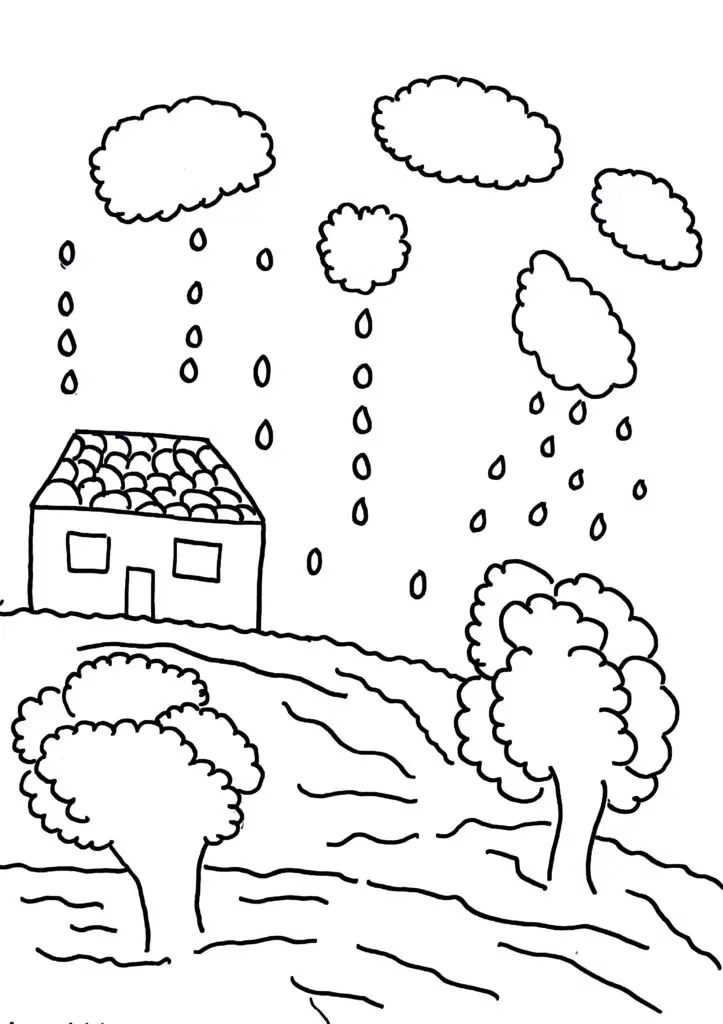
Nature coloring pages - Heavy rain
Information about Rain
1. Raindrops exist in which shape?
The raindrop’s shape depends on the size of the water droplet. The raindrops have a spherical, flattened spherical, or hamburger bun-like shape. The size of a raindrop affects the speed of falling. There is a directly proportional relation between the size of a raindrop and the speed of falling. As the size of a raindrop increases, the speed of falling also increases. The air present in the atmosphere affects the shape of raindrops.
2. Do you know some of the wettest places in the world?
Mount Waialeale, Hawaii, is one of the wettest places on earth. It has an annual rainfall of about 450 inches (11700 mm). Cherrapunji in Meghalaya, India, is also one of the wettest places in the world. Cherrapunji is located south of the Khasi Hills. Cherrapunji has an annual rainfall of about 11430 mm. A village named Mawsynram, which is located in the East Khasi Hills of Meghalaya, India, is among the wettest places in the world. There is about 11872 mm of rainfall annually in Mawsynram village. The geographical location of Mawsynram is the cause of such high rainfall. The village is located near the Bay of Bengal. The moist air from the Bay of Bengal hits the mountains and leads to heavy rainfall.
3. Do you know some of the driest places in the world?
The McMurdo Dry Valleys, situated in Antarctica, are the driest polar places on earth. The McMurdo Valleys have very low humidity in the surrounding atmosphere. The McMurdo Dry Valleys have not seen rain for approximately two million years. The Atacama Desert, located in Chile, is the driest nonpolar place in the world. The average rainfall in the Atacama Desert is about 1 mm. The cold Humboldt Current offshore and the Andes Mountains are among the driest nonpolar places. The cold Humboldt Current offshore and the Andes mountains are responsible for the climatic conditions in the Atacama Desert.
4. What is the phantom rain?
Phantom rain is an observable event of the atmosphere where rain falls from the clouds, but it is unable to reach the ground. There is sublimation or evaporation of the water droplet before it touches the ground. Phantom rain occurs in hot or dry places such as deserts. Extreme heat and less humidity in the atmosphere cause water droplets to evaporate before they touch the ground. Phantom rain is also called “virga.”
5. Do you know about acid rain?
Chemicals in the surrounding atmosphere, such as sulfur dioxide and nitrogen oxides, cause acid rain.
Sulfur dioxide and nitrogen oxide react with oxygen present in water molecules. The end products of the reaction are sulfuric acid and nitric acid, respectively. The acid rain then falls on the ground, which leads to harmful effects on the ecosystem, whether it may be human, forest, animal, bird, or marine animals.
References
https://www.britannica.com/science/rain
https://kids.britannica.com/scholars/article/rain/62486
https://gpm.nasa.gov/science/anatomy-of-a-raindrop
https://en.wikipedia.org/wiki/Virga
https://kids.britannica.com/scholars/article/acid-rain/3549
https://explore.britannica.com/explore/savingearth/acid-rain
https://en.wikipedia.org/wiki/Atacama_Desert
https://science.howstuffworks.com/environmental/earth/geology/driest-place-on-earth.htm
https://www.nasa.gov/image-article/dry-valleys-antarctica/
https://www.wikiwand.com/en/articles/McMurdo_Dry_Valleys
To download PDF click here – Information about rain
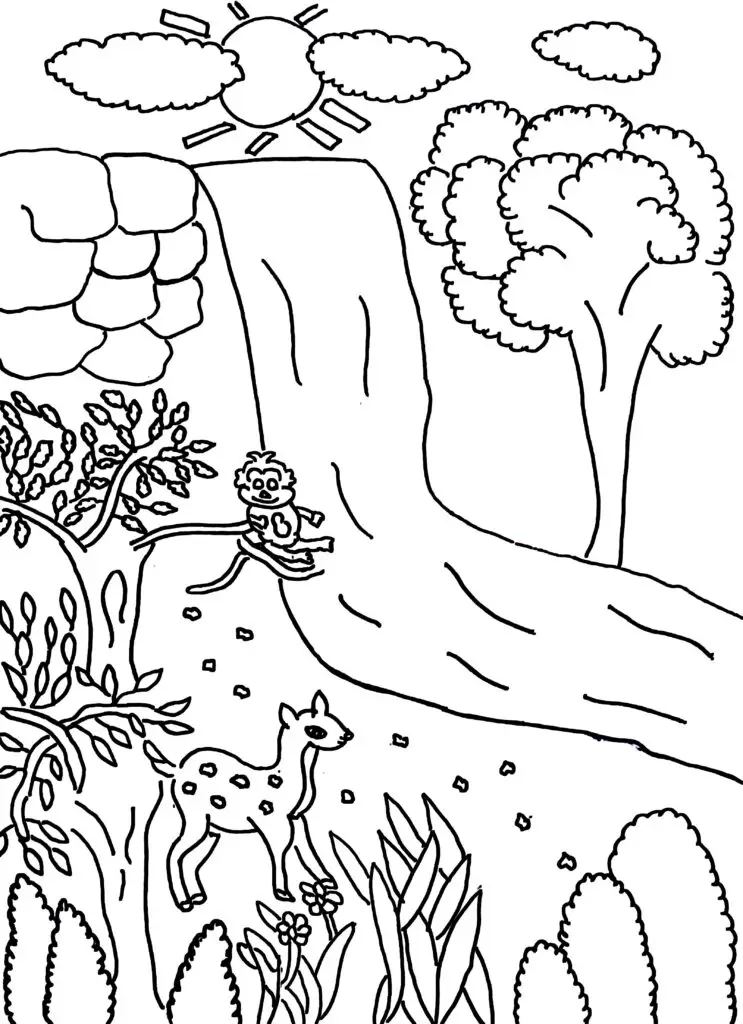
Nature coloring pages- Forest view
Information about forest
1. Which types of forests?
Depending on the basis of latitude, there are three main types of forests. These are as follows:
a) Tropical forest —
Tropical forests are located near the equator. These are characterized by warm temperature conditions, ample rainfall, high diversity of life, and dense distribution of plants. Tropical forests are distributed between the Tropic of Cancer and the Tropic of Capricorn.
b) Temperate forest –
Temperate forests are at the midpoint of the equator. There are four different seasons in the temperate forest, which show variation in temperature conditions.
c) Boreal forest (tiaga) — Boreal forests are located at high northern latitudes. Boreal forests are characterized by cold temperature conditions and coniferous (evergreen) trees that stay green throughout the year.
2. What is the ecological importance of forests?
About 31% of the earth’s surface is covered with forest. Most animal and plant species are found in the forest. Forests are an essential component for climate control. They inhale carbon dioxide and exhale oxygen. Forests have been a crucial component in the natural water cleaning process. Forests enhance the atmospheric moisture level and hence, ultimately, play an essential role in rainfall. They also play a role in preventing the erosion of soil.
3. Why are forests important for humans?
Forests provide wood. Wood is a raw material for combustion and construction. They also provide food such as fruits, nuts, and berries. They also enhance the physical and mental health of human beings. Many of the plants that are found in forests have medicinal value.
References
https://en.wikipedia.org/wiki/Tropical_forest
https://earthobservatory.nasa.gov/biome/biorainforest.php
https://science.howstuffworks.com/environmental/earth/geophysics/tropic-of-capricorn.htm
https://en.wikipedia.org/wiki/Tropic_of_Capricorn
https://en.wikipedia.org/wiki/Tropic_of_Cancer
https://science.howstuffworks.com/environmental/earth/geophysics/tropic-of-cancer.htm
https://earthobservatory.nasa.gov/biome/biotemperate.php
https://www.britannica.com/science/taiga
To download PDF click here – Information about forest
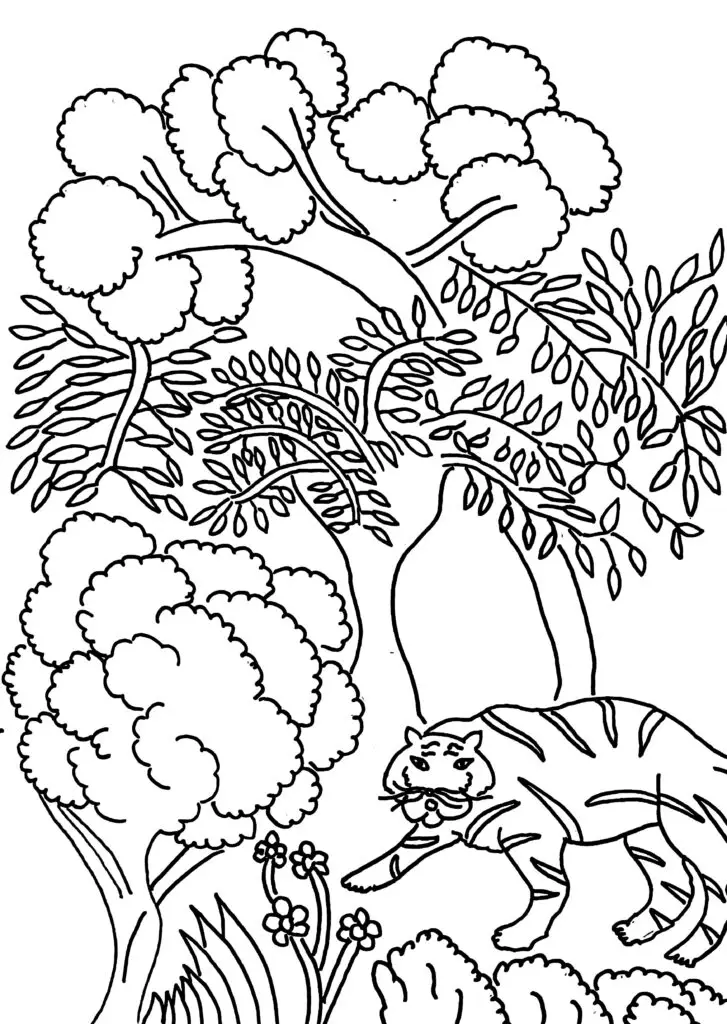
Nature coloring pages - Tiger in the forest.
Forest types
a) Coniferous forest —
Coniferous forest has coniferous trees, which means trees have needle-like leaves along with a waxy layer to reduce water loss. Coniferous forests have trees such as pines, spruces, and firs. These trees bear cones instead of flowers, and within the cone there are seeds. Coniferous forests are found in North America, Europe, and Asia, in the Northern Hemisphere, at high latitudes. These forests experience long, severe winters with cold temperatures and short, cool, and moist summers.
b) Deciduous forest –
Deciduous forest trees lose their leaves once a year. The process of shedding leaves helps to survive extreme weather conditions. There are four seasons in this region where deciduous forests exist. The deciduous forests are again subclassified as a) temperate deciduous forests and b) tropical deciduous forests.
Temperate deciduous forests are found in the Northern Hemisphere, including North America, Europe, and parts of Asia. In the temperate forest, leaves change their color in autumn and fall off in winter.
Tropical deciduous forests are also known as monsoon forests. There are two seasons, a long summer season and a mansoon season. Tropical deciduous forests developed in regions such as India, Northern Australia, and Central America.
c) Evergreen forests —
In evergreen forests, green leaves remain on the tree for the entire year. Evergreen forests are distinguished by a continuous canopy, high rainfall, consistent temperatures, and overgrown vegetation. Evergreen forests are located near the equator and in areas with heavy rainfall. Evergreen forests are subdivided into tropical evergreen forests, temperate evergreen forests, and Mediterranean woodlands.
Tropical evergreen forests — there is heavy rainfall in the tropical evergreen rainforest. There is a lush green, closely packed, and a tall tree.
Temperate evergreen forests are defined by coniferous and holly trees. These trees can survive in cold and warm conditions. They are located in areas with a short dry season, high altitude, and regular rainfall.
Mediterranean Woodlands – Mediterranean Woodlands are located in the Mediterranean climate region, some parts of Australia, and South Africa as well.
d) Mangrove forests –
The trees that are located in mangrove forests are able to survive in environments such as saltwater, coasts, estuaries, and lagoons. They play an important role in coastal protection and carbon sequestration. These forests provide timber and food to people who reside in coastal regions. The Sundarbans, Bhitarkanika, and the Godavari-Krishna delta are examples of mangrove forests.
e) Montane forest –
Montane forests are located at high altitudes on mountains. Montane forests are defined by cooler temperatures, rugged terrain, and high humidity. They are important for watershed protection, soil stability, and carbon sequestration.
e) Thorn forest –
Thorn forests are defined by low water-requirement trees in areas with low rainfall. Thorn forests are found in Southwestern North America, Africa, South America, India, and Australia. Plants that are present in thorn forests, have long roots, small, and thick leaves.
References –
https://www.geeksforgeeks.org/social-science/coniferous-forests-temperature-climate-location-facts/
https://www.geeksforgeeks.org/social-science/tropical-deciduous-forests/
https://en.wikipedia.org/wiki/Temperate_deciduous_forest
Coniferous Forest
https://www.britannica.com/science/temperate-forest#ref591903
https://www.geeksforgeeks.org/social-science/temperate-evergreen-forests/
https://www.geeksforgeeks.org/social-science/tropical-evergreen-forests/
https://earthobservatory.nasa.gov/biome/biotemperate.php
https://www.britannica.com/science/temperate-forest
https://www.britannica.com/plant/Mediterranean-vegetation
https://en.wikipedia.org/wiki/Mediterranean_forests,_woodlands,_and_scrub
https://en.wikipedia.org/wiki/Mangrove_forest
https://en.wikipedia.org/wiki/Estuary
Montane Forests
https://www.geeksforgeeks.org/social-science/montane-forests-of-india/
To download PDF click here – Forest types
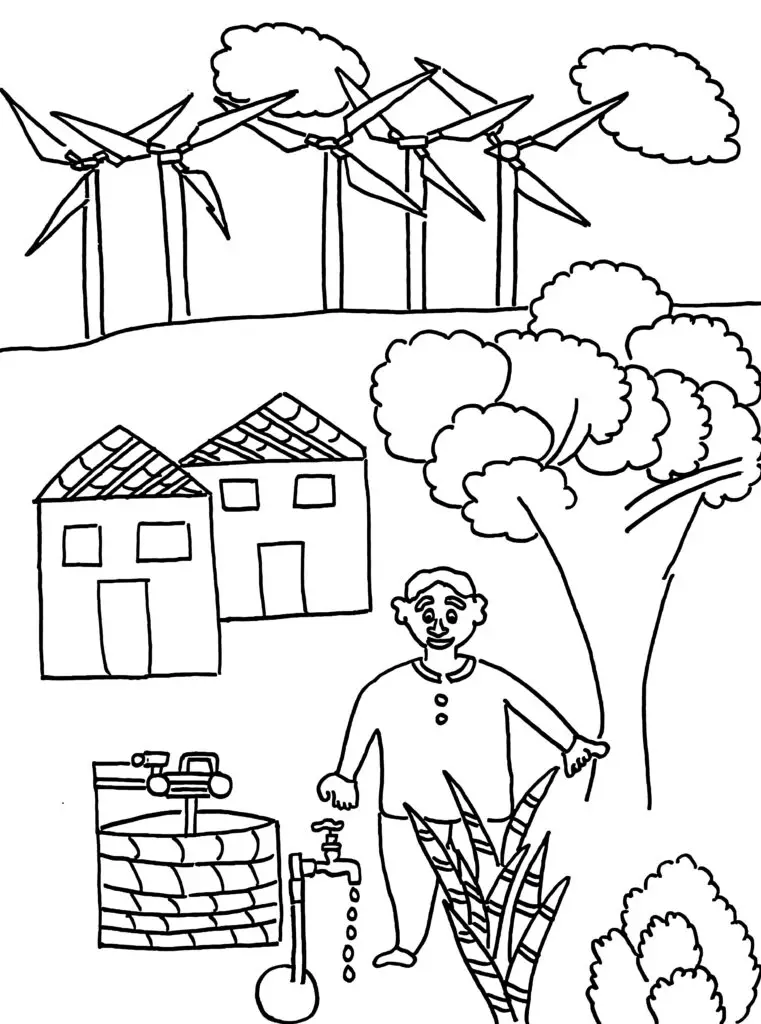
Nature coloring pages -Wind energy generation
Information about wind energy
1. Are there any energy production methods that do not require water?
Wind energy is an energy production method where there is no need for water. Huge amounts of water are utilized for cooling by coal, nuclear, and natural gas plants. During electricity generation, the wind’s kinetic energy is transformed into mechanical energy, which then becomes electrical energy. The wind energy method is environmentally beneficial.
2. What do you know about wind farms?
In a wind farm, there are many wind turbines that are located in the same area. The number of wind turbines varies. For example, there are about 100 wind turbines located in the same area. These turbines are interconnected by underground cables that supply electricity to a transformer substation.
3. The biggest wind farm in the world is located in which country?
Located in China, the Gansu Wind Farm is the largest wind farm in the world. With a capacity of 20 GW and over 7,000 turbines, the Gansu wind farm is the world’s largest wind power installation.
4. Can excessive wind speed damage wind turbines?
Yes, excessive wind speed can damage the wind turbine. Wind turbines can tolerate up to the speed of 90 km/hr wind. When wind speed increases above 90 km/hr, turbines are shut down to prevent damage.
5. When was the first modern turbine built?
The first modern wind turbine was built in 1941. It was the Smith-Putnam wind turbine that was in Vermont.
References
https://en.wikipedia.org/wiki/Electricity_generation
https://www.wikiwand.com/en/articles/Gansu_Wind_Farm
https://en.wikipedia.org/wiki/Wind_power
To download PDF click here – Information about wind energy
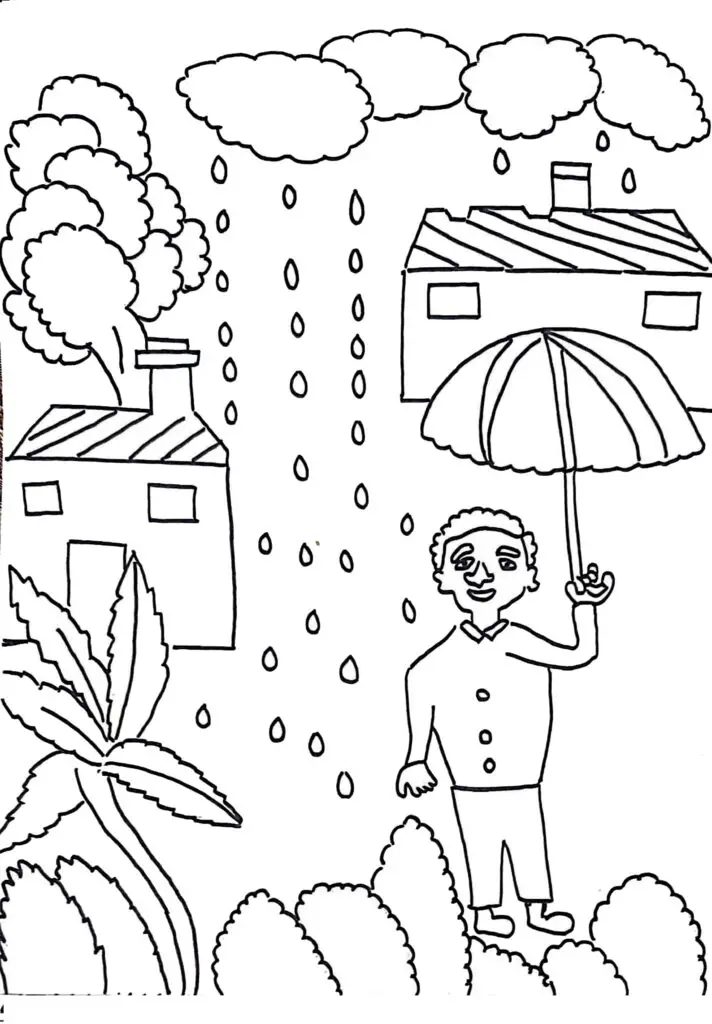
nature coloring pages- a man satanding in the rain
Flood
1. What types of floods?
There are three types of floods. These include a) flash flood, b) river flood, and c) coastal flood.
a) Flash flood — When there is a cloudburst or torrential rainfall, it leads to a rise in water level very fast in rivers, streams, channels, or roads. The phenomenon is called a flash flood. The flash flooding occurs within 6 hours of rainfall.
b) River flood – When there is continuous and slow rainfall, melting of snow, or heavy rainfall for a short duration, it leads to a rise in river level. The phenomenon is called a river flood.
c) Coastal floods — Coastal floods are caused by a storm surge or tsunami, resulting in a rise in the water level along coastal regions.
2. What do you mean by “floodplain”?
A Floodplain is a flat area of land by the side of the river that is susceptible to flooding. A floodplain is formed due to the deposition of sediment and silt from floodwater. When a river’s banks erode, a floodplain is formed. Floodplains occupy approximately two percent of the land surface. There are some benefits and some drawbacks to floodplain areas. It acts as a natural pathway for floodwater and also acts as a habitat for wildlife. The soil of the floodplain area is rich in nutrients and important for crop development. The floodplain areas act as storehouses for rainwater, which release water slowly during the time period. Residential areas located near floodplains are vulnerable to damage from floods.
3. What do you mean by wetland?
“An intermediate zone between land and aquatic systems, defined by water saturating the soil or covering the land, is called a wetland. Wetlands serve as natural filters, purifiers, and sponges; they reduce flood effects and thus play a role in water cycle regulation. Wetlands are classified on the basis of their location and properties, and are broadly categorized as, a) coastal or tidal wetlands, and b) inland or non-tidal wetlands.“
Coastal wetlands — Coastal wetlands are found along coastlines, such as mangroves, tidal flats, and coastal reefs. They protect coastlands from erosion and storm bursts. Salt marshes, mangrove forests, and mudflats are some examples.
b) Inland or nontidal wetlands– These are located far away from coastland. Inland wetlands are subclassified as i) swamps, ii) marshes, iii) peatlands, iv) shallow lakes, or ponds.
i) Swamp — In such wetlands there are woody plants and shrubs that are nourished by surface water. The Okefenokee Swamp in the United States, the Sundarbans mangrove forest in India and Bangladesh, and the Myristica swamp forests of the Western Ghats in India are examples of swamp wetlands.
ii) Marshes – In such areas there are herbaceous plants that suit wet soil, whether it is tidal or non-tidal. The Everglades in Florida, the prairie potholes in North America, the Pantanal in South America, and the Sunderbans in India/Bangladesh are examples of marsh wetlands.
iii) Peatlands — These areas have a layer of dead plant material and accumulate large amounts of water. The Ruoergai plateau in the Himalayas, temperate peatlands like those in Ladakh, and tropical peat swamp forests in Southeast Asia are some examples.
iv) shallow lakes and ponds — These are places that have persistent or semipersistent water with minimal flow.
Wetlands play a crucial role in the maintenance of ecosystems. They provide food, shelter, and nests for plants as well as animal species. They accumulate a large quantity of carbon and thus play a role in environmental regulation. They also act as a resource for human well-being.
References
https://kids.nationalgeographic.com/science/article/flood
https://en.wikipedia.org/wiki/Flood
https://www.britannica.com/science/flash-flood
https://www.wikiwand.com/en/articles/coastal_flooding
https://kids.britannica.com/scholars/article/flood/34598
https://en.wikipedia.org/wiki/Floodplain
https://en.wikipedia.org/wiki/Wetland
https://kids.britannica.com/scholars/article/wetland/76708
https://en.wikipedia.org/wiki/Tidal_marsh
To download PDF click here – Flood
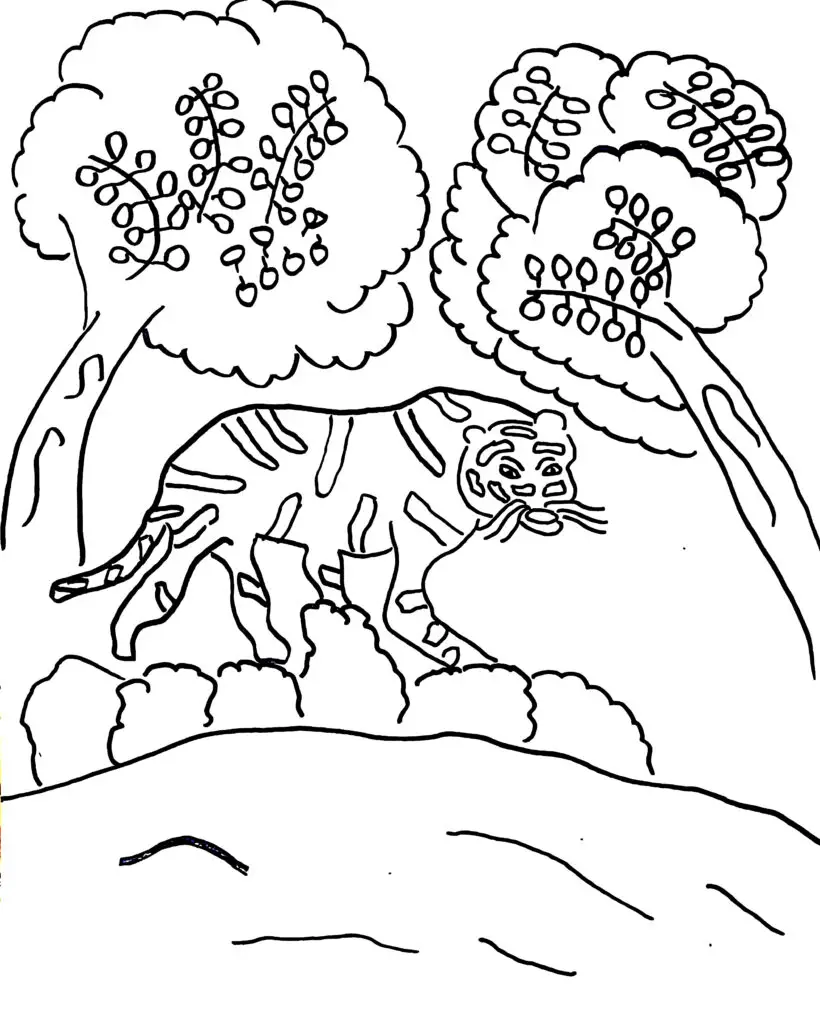
Nature coloring pages- Tiger near the water resource
Royal Bengal tiger
1. How are Bengal tigers distinguished from other tiger subspecies?
Bengal tigers are distinguished from other tiger subspecies by their color and stripes. They have an orange-colored coat with distinct brownish-to-black stripes, and a rare white color variant also exists.
2. What are the other names for the Bengal tiger?
The Bengal tiger is also known as the Indian tiger or the Royal Bengal tiger. British settlers first saw the subspecies of tiger in the Bengal region and named it the Bengal tiger. As the subspecies is found exclusively on the Indian subcontinent, it is also called the Indian tiger.
3. Where are the Bengal tigers found?
The Bengal tigers are found in the hot and humid forests and wetlands of India, Bangladesh, Bhutan, and Nepal.
4. What is the reason behind the white color of the tiger?
The reason behind the white tiger is a genetic mutation known as leucism. This genetic mutation causes a lack of red and yellow pigment pheomelanin, which is responsible for the tiger’s orange coat. The black stripes still exist on the white coat because black stripes are due to another pigment, eumelanin.
References
https://en.wikipedia.org/wiki/Bengal_tiger
https://en.wikipedia.org/wiki/Melanin
To download PDF click here – Royal Bengal tiger
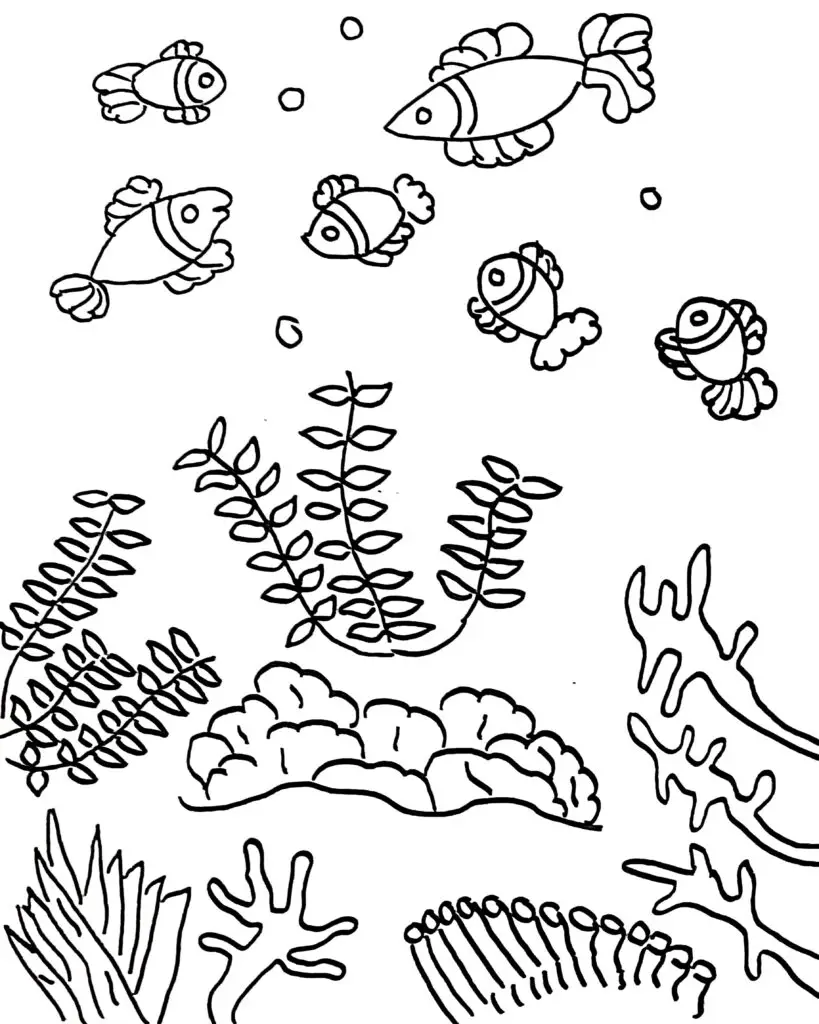
Nature coloring pages- Deep sea fish and plants.
Aquatic plants
1. What are hydrophytes?
Hydrophytes are plants that are adapted to live in aqueous environments such as ponds, lakes, and rivers. They are either fully submerged, floating on the surface, or partially submerged. Compared to other plants, hydrophytes lack a completely developed root system. They have spongy tissues with air spaces in the stems, roots, and poorly developed xylem vessels in their leaves.
2. What are Macrophytes?
Macrophytes are big-sized plants that can be seen with the naked eye and develop in or near water. These plants are either floating on the water’s surface, completely underwater, or rooted in shallow water or sediments.
3. How are aquatic plants categorized?
Aquatic plants are categorized into four groups: emergent plants, submerged plants, floating leaf plants, and free-floating plants.
a) Emergent plants are plants that develop in the water but extend their leaves and stems over the surface. These adaptations help them to do food photosynthesis and to pollinate the flowers. Cyperus papyrus, Typha species, flower rush, wild rice, and purple loosestrife are examples of emergent plants.
b) Submerged plants: Submerged plants are plants that develop completely underwater. They have either deep root systems or free-floating roots and get nourished by absorbing nutrients from the water with the help of their leaves and stems. Elodea, eelgrass, American pondweed, and hornwort are some examples of submerged plants.
c) Floating leaf plants have root systems that are attached to the bottom of the water, and their leaves float on the surface of the water. They have unique, lightweight, spongy tissue known as aerenchyma. They have broad, plate-like, and flat leaves. They have extended, thin, flexible stems along with hollow channels. Water lilies and pondweeds are some examples of these plants.
d) Free floating plants: Plants that float on the exterior surface of water are known as free-floating plants. They possess a free-floating root system, a waxy coating on their leaves to repel water, and can be easily relocated by wind. Duckweed, water lettuce, watermeal, and mosquito fern are some examples of free-floating plants.
References
https://en.wikipedia.org/wiki/Aquatic_plant
https://www.britannica.com/plant/tree/Tree-bark
To download PDF click here- Aquatic plants
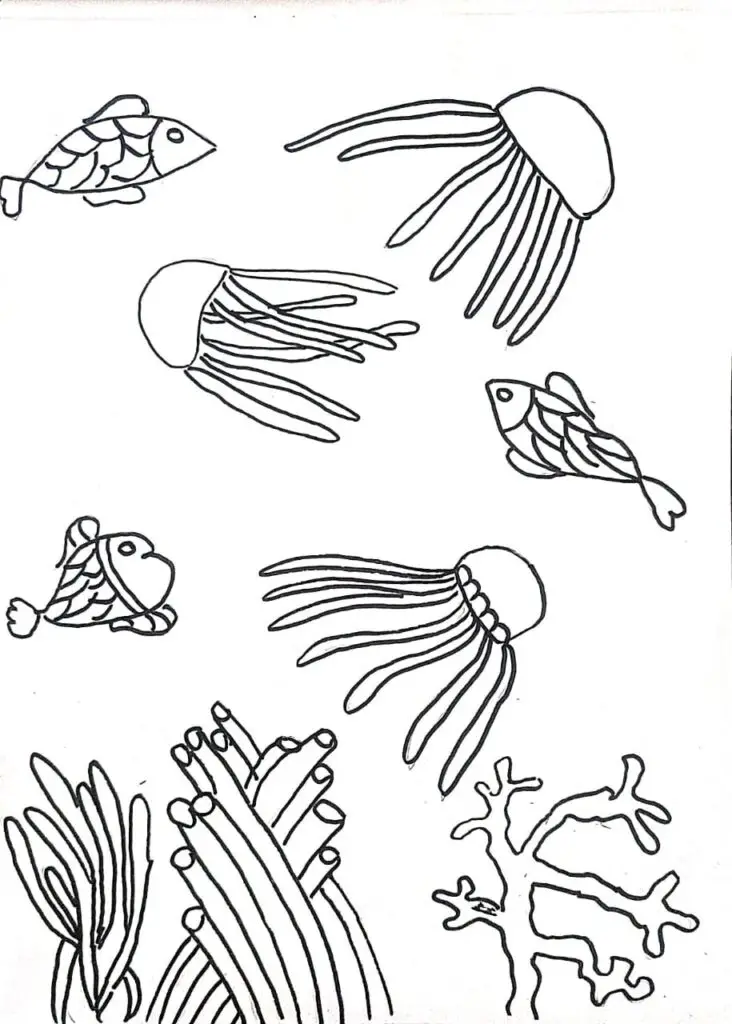
Nature coloring pages -Jellyfish in deep sea waters.
Jellyfish species
1. How do jellyfish produce light?
Jellyfish are sea creatures that have the capability to produce light. This is used as a defense strategy by jellyfish to protect themselves from predators. They also use it for hunting and communicating with each other. They have a chemical substance called luciferin in their body, which is a light-producing substrate. The luciferin undergoes a chemical interaction with oxygen in the presence of an enzyme, luciferase. This reaction leads to the production of light energy, such as blue or green. Some kinds of species have a green fluorescent protein that produces green light. This phenomenon of producing light is called bioluminescence. Crystal jelly, Venus’s girdle, Atolla jellyfish, and moon jelly are some examples of jellyfish species that produce light.
2. Do you know that some species of jellyfish are immortal?
Yes, some species of jellyfish, like Turritopsis dohrnii, are capable of reverting their life cycle from the adult stage to a baby stage through a process called transdifferentiation. They undergo this process in response to injury, starvation, or old age. This happens because adult cells can revert into different cell types due to specific genes.
3. Which is the most poisonous jellyfish in the world?
Among all the species, the box jellyfish, like Chironex fleckeri, is the one that is the most poisonous and is able to kill humans in seconds through its sting.
4. Do you know that a few jellyfish are practically invisible?
Yes, there are a few jellyfish that are practically invisible, as they are very small, measuring about 0.5 millimeters in diameter. The jellyfish belonging to the genera Staurocladia and Eleutheria are the smallest.
5. Is there a definite number of tentacles in the jellyfish?
No, there is no definite number of tentacles in jellyfish. The number, size, color, and function of tentacles differ from species to species. For example, box jellyfish possess about 15 tentacles, which are large, while common moon jellyfish possess about 100 tentacles that are small-sized.
References
https://en.wikipedia.org/wiki/Turritopsis_dohrnii
https://animals.howstuffworks.com/marine-life/bioluminescent-jellyfish.htm
https://animals.howstuffworks.com/marine-life/most-dangerous-jellyfish.htm
https://www.britannica.com/science/How-Many-Tentacles-Does-a-Jellyfish-Have
https://www.britannica.com/animal/What-Is-the-Most-Venomous-Jellyfish