



Birds coloring pages offer a fun and educational way for kids and adults to engage with nature. These printable pages feature a variety of birds—from the bright red cardinal to the elegant peacock—each waiting to be brought to life with color. Not only do they spark creativity, but they also introduce fun and interesting facts about birds, such as how hummingbirds can flap their wings up to 80 times per second!
First, they allow learners to explore natural patterns like feathers and beaks. Second, they support fine motor development through careful coloring.Moreover, these pages are great for sparking curiosity. Did you know some birds, like parrots, can mimic human speech? Or that the Arctic tern migrates farther than any other bird—over 40,000 miles each year? These fun facts can be included alongside images to enrich the coloring experience. Created for all skill levels, bird coloring pages are perfect for classrooms, homeschooling, or quiet time at home. Because they’re printable, they can be used over and over again. With detailed designs and fascinating bird trivia, these pages make learning both artistic and memorable.
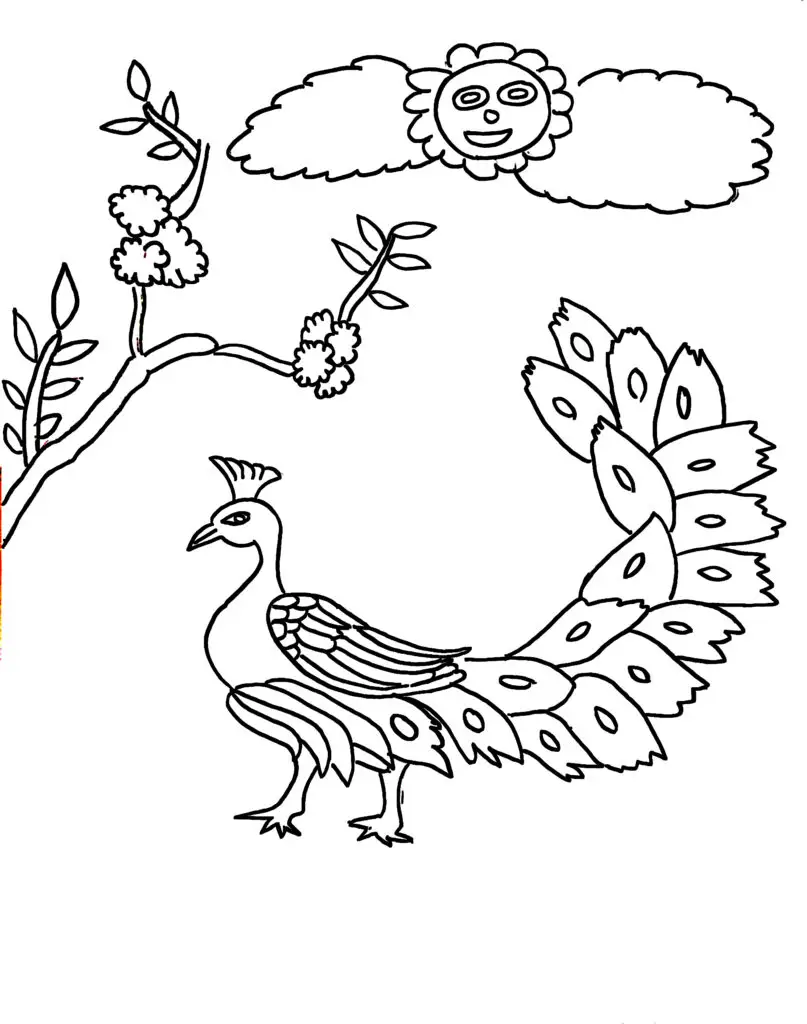
Birds coloring pages- Peacock in a garden
Interesting Facts about birds (facts about a peacock)
Do you know what male and female peacocks are called?
“Peacocks are generally seen in a forest, during the rainy season, or in bird and animal sanctuaries, but did you know male and female peacocks are called by different names? The male is generally called ‘a peacock’. The female is known as ‘a peahen’. While both males and females are combined, they are called peafowl.”
2. Do you have an idea how many species of peafowl there are in the world?
“While, taking into consideration peafowl, there are three extensively-studied species of peafowl .Out of the extensively -studied species, one with a vernacular name, Indian or blue peafowl, is binomial Pavo Cristatus . One with a vernacular name, “Green peafowl or Javanese peafowl,” is the binomial Pavo Muticus . One with a trivial name, Congo peafowl, is the binomial name “Afropavo Congensis.”
3. Do you know where peacocks reside?
Peacocks live in forests as well as in zoos. Generally, their average lifespan is about 20 years, but in controlled conditions, it can increase to 40 years. The reason for the increase in lifespan is protection from predators, proper food ingestion, and care taken by caretakers. “In their natural habitat, they live in low-lying areas of forest during the day, while during the nighttime, they rest high in the trees.”
4. Can a peacock run?
Although the size of a peacock is large, they are able to run at speeds of 16 km/hr, to save themselves from predators, because they have strong legs.
5. Did you know that male peacocks undergo a molting process once a year?
“The male peacock sheds its tail after mating season once a year. can regenerate after some time period. This process is called the molting and involves the regeneration of the tail feathers.”
References
- peacock – Scholars | Britannica Kids | Encyclopedia
- https://www.britannica.com/animal/peacock
- https://www.treehugger.com/peacock-facts-5094142
- https://en.wikipedia.org/wiki/Peafowl
- https://www.sciencekids.co.nz/sciencefacts/animals/peacock.html
- https://animals.howstuffworks.com/birds/peacock-feathers.htm
To download PDF click here – Interesting facts about birds (facts about a peacock)
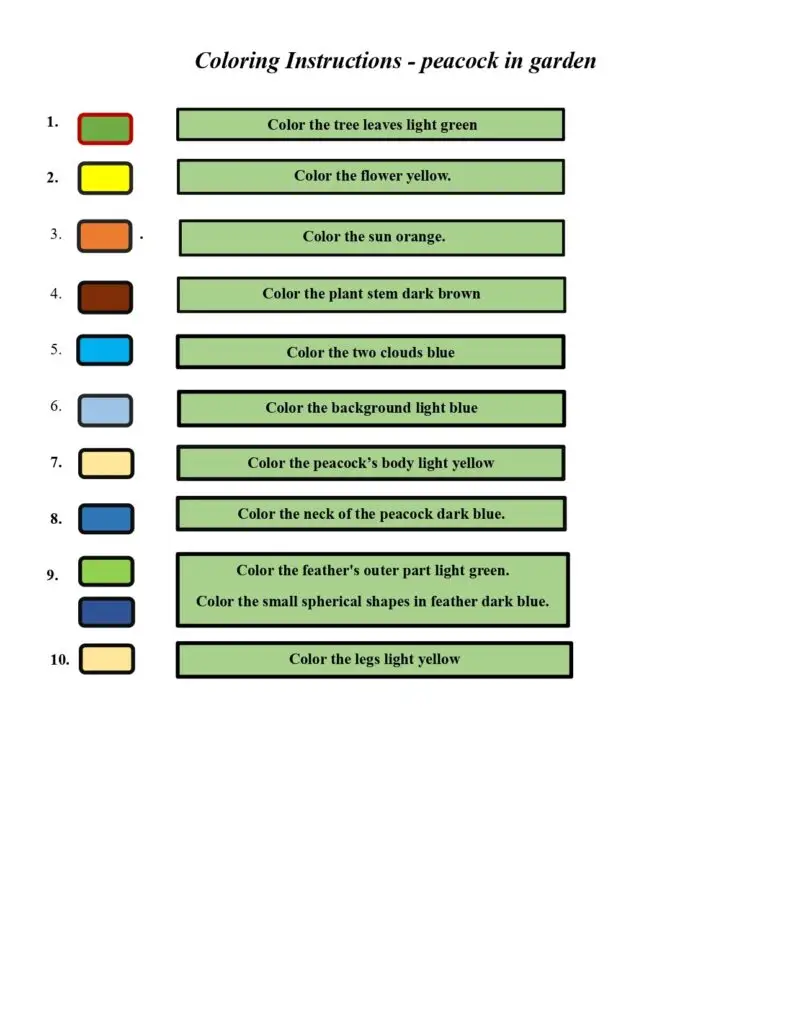
Coloring instructions - peacock in a garden
Birds Coloring pages -Peacock in a Garden
This page shows a peacock standing in a garden. The peacock is about to open his feathers. You can see one of the stems of a plant where leaves and beautiful flowers are grown and there are two clouds present in the sky and between these two clouds you can see the sun shining brightly. Children can color the peacock with a blue-green color and clouds with blue-colored colours. Children will enjoy coloring this beautiful peacock.
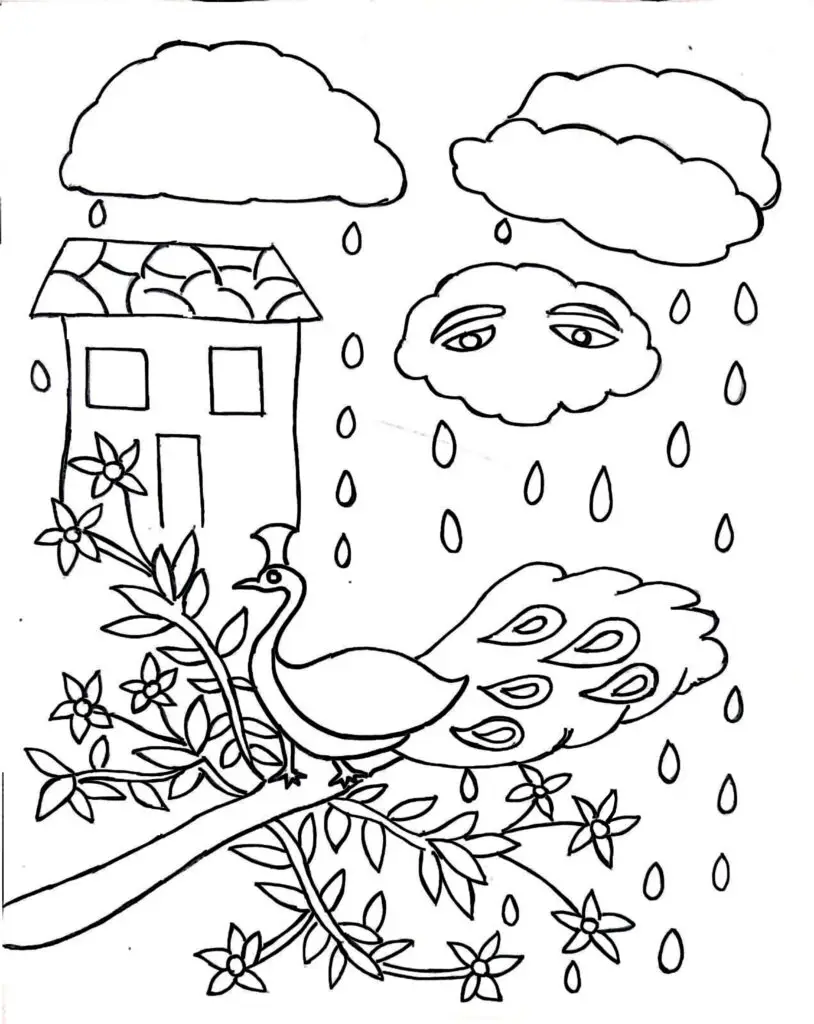
Birds coloring pages - Peacock outside the house
Peacock facts
1. Did you find the habitat of peafowl?
All these species of peafowl are scattered into different geographical areas of the world. When talking about Indian peafowl, its native land is Asian countries, which include India and Sri Lanka. When talking about green peafowl, it is native to southeast Asian countries, which include Thailand, Indonesia, Myanmar and India. When speaking about Congo peafowl, it’s exclusively native to the Democratic Republic of Congo.
2. How can one identify species of peafowl?
Males of the blue and green peafowl species have differently colored feathers, which allows for differentiation. Blue peacocks have a metallic blue-green plumage, while green peacock have blue-bronze plumage. In contrast, females of both species have muted brown or gray plumage.
3. Do you know the difference between a peacock and a peahen?
The main distinguishing feature between a peacock and a peahen is the multicolored tail; peacocks are male with long, colorful tails (trains), while peahens are females, who lack them.
References
- peacock – Scholars | Britannica Kids | Encyclopedia
- https://www.britannica.com/animal/peacock
- https://www.treehugger.com/peacock-facts-5094142
- https://en.wikipedia.org/wiki/Peafowl
- https://www.sciencekids.co.nz/sciencefacts/animals/peacock.html
- https://animals.howstuffworks.com/birds/peacock-feathers.htm
To download PDF click here – Interesting facts about birds (Peacock facts)
Birds coloring pages -Peacock outside the house
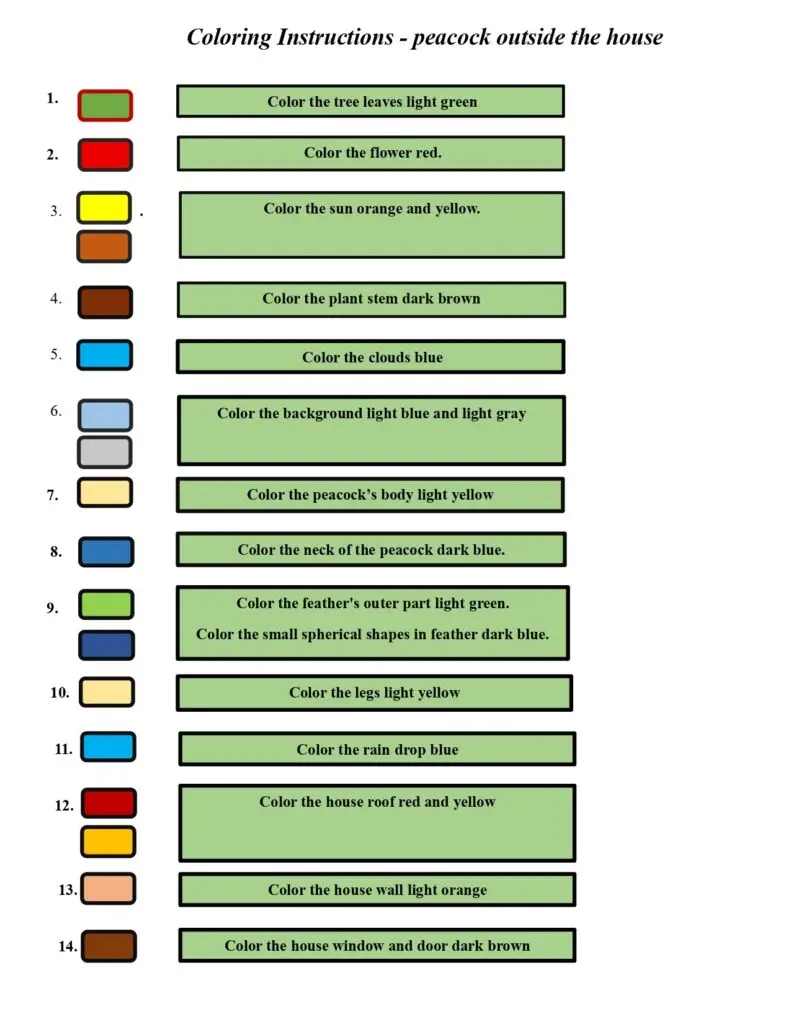
Birds coloring pages – Peacock outside the house
A vibrant peacock sits gracefully on a flowered plant stem in the garden outside a house. Behind the colorful bird, thick clouds and the bright sun create a dramatic sky. Rain falls gently around the peacock, making its feathers glisten with nature’s sparkle. The garden bursts with life as the animal proudly displays its fan of brilliant colors. Each detail brings out the charm perfect for birds coloring pages.
Children and adults alike can enjoy filling this lively scene with their favorite shades. The combination of rain, sunshine, and the majestic peacock makes a magical outdoor setting for creative fun.
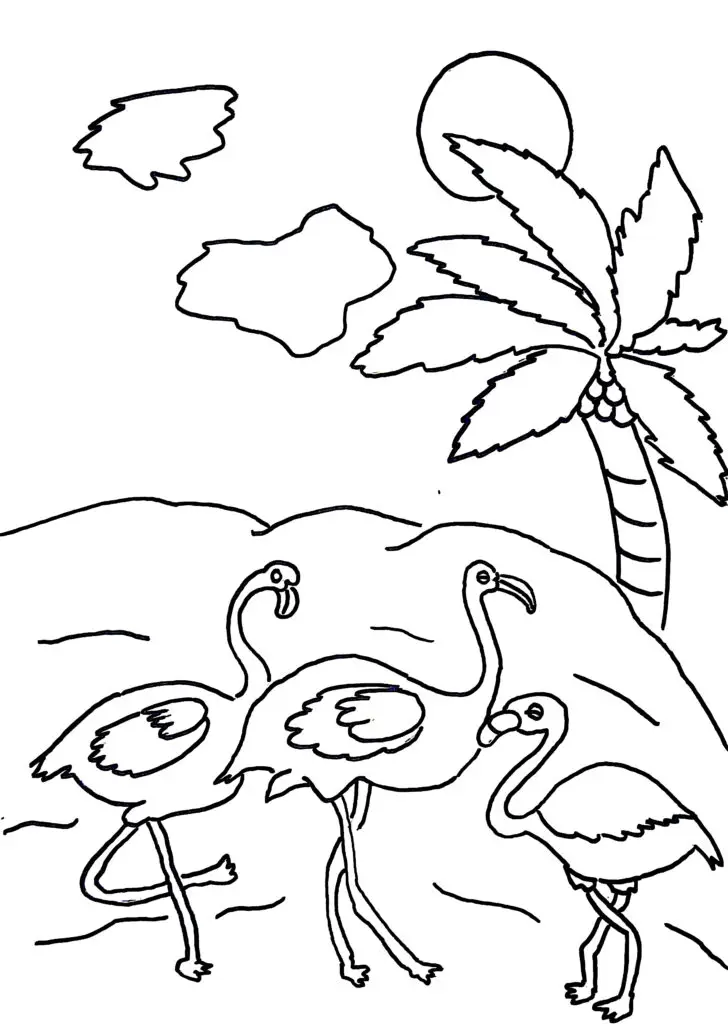
Birds coloring pages -Flamingo birds
Flamingo facts
1. How many species of flamingo birds are there?
Flamingo birds exist in different parts of the world. The well-recognized species of flamingo birds are the Chilean flamingo, the Caribbean flamingo, the Greater flamingo, the Andean flamingo, the Lesser flamingo and the James’s flamingo, which are native to tropical and subtropical regions of the world.
2. Do you know what food flamingos eat?
Flamingos eat algae, blue-green algae, brine shrimp, insects, mollusks, and plant seeds in shallow waters. These food are enriched with carotenoids. and have red, yellow, and orange-colored pigments that are absorbed by flamingos.
3. Do you know about the habitat of the flamingo?
Flamingos can survive in different kinds of conditions, including lagoons, estuaries, coastal and inland lakes, and mudflats. Flamingos also survive in the saltiest places in the world, where other animals cannot survive. They are found in tropical and subtropical regions.
4. Do you know the native place of the flamingos?
The American flamingo (Phoenicopterus ruber), Chilean flamingo (Phoenicopterus chilensis), Andean flamingo (Phoenicoparrus andinus), and James’s flamingo (Phoenicoparrus jamesi) are four species of flamingos native to different regions of the Americas. The American flamingo, also called the Caribbean flamingo, is found on the Caribbean islands, Galápagos islands, parts of North America, and along the northern coast of South America. Chilean flamingos are found in South America. Andean flamingo and James’s flamingo live in the Andes mountains of South America. The Greater Flamingo (Phoenicopterus roseus) and the Lesser Flamingo (Phoeniconaias minor) are two species that are native to Afro-Eurasia. The Greater flamingo is native to Africa, Southern Europe, and Southwest Asia. The Lesser flamingo is native to East Africa and Northwest India
References
- https://www.britannica.com/animal/flamingo-bird
- https://en.wikipedia.org/wiki/Flamingo
- https://seaworld.org/animals/all-about/flamingos/characteristics/
- https://kids.britannica.com/scholars/article/flamingo/34480
- https://www.livescience.com/27322-flamingos.html
- https://www.sciencekids.co.nz/sciencefacts/animals/flamingo.html
- https://kids.nationalgeographic.com/animals/birds/facts/flamingo
To download PDF click here – Flamingo facts
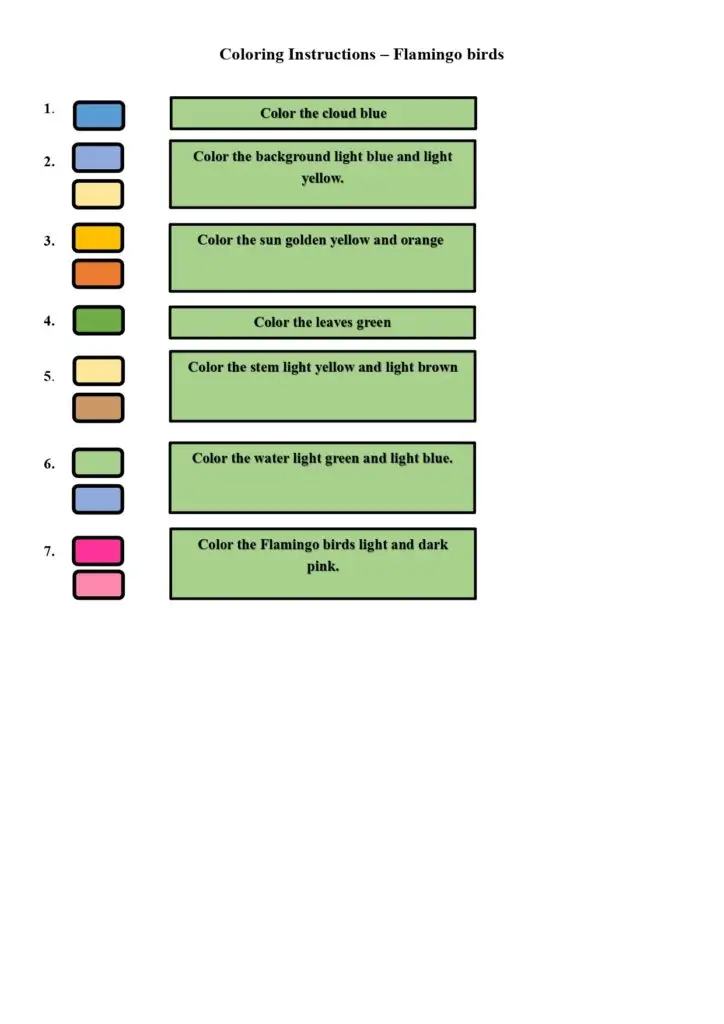
Coloring instructions-Flamingo birds in shallow water
Birds coloring pages (Flamingo birds in the shallow water.)
Flamingo birds stand gracefully in shallow water, their long legs reflecting in the still surface. The sun glows warmly above, casting golden light across the scene. Two clouds float gently in the sky, adding softness to the vivid backdrop. Meanwhile, the calm water enhances the birds’ colorful beauty. In fact, their bright plumage contrasts perfectly with the soft sky and warm sunlight. As a result, the entire scene feels peaceful yet full of life. Therefore, this setting makes a perfect inspiration for bird coloring pages, allowing artists to explore bold shades and tranquil scenery alike.
Moreover, children and adults alike can enjoy recreating this natural beauty through creative coloring. Clearly, such a peaceful landscape encourages imagination and appreciation for wildlife. Instead of busy backgrounds, the focus remains on the birds and their calm environment.
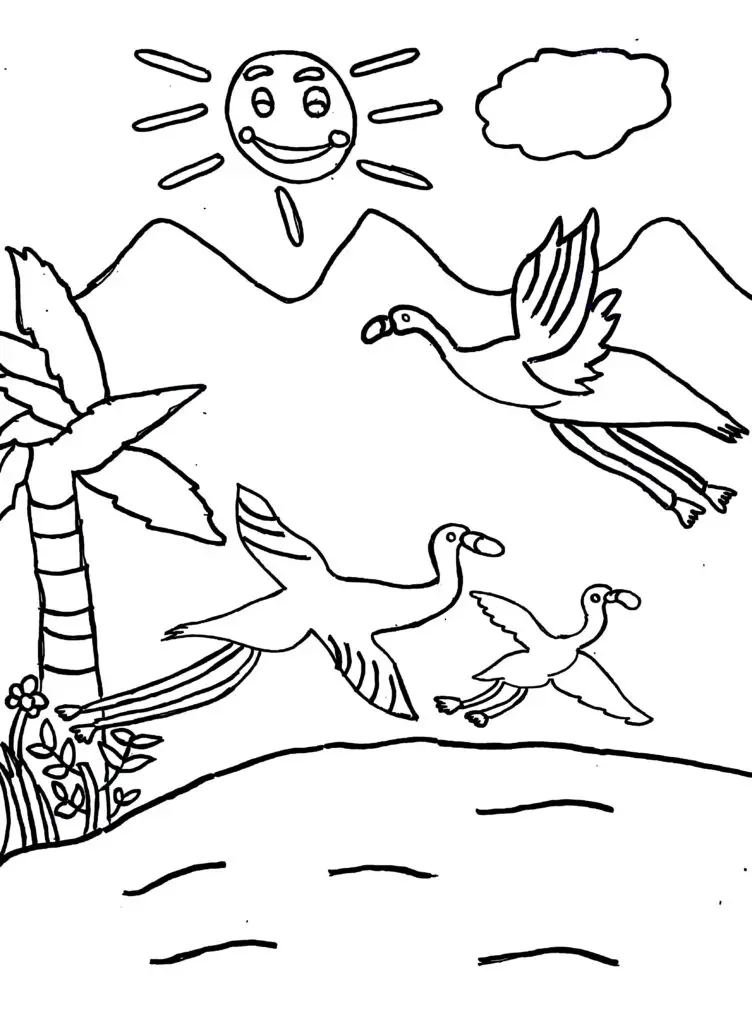
Birds coloring pages- Flying flamingo birds
Flamingos interesting facts
1. Do you know why flamingos prefer flying at nighttime and at high altitude?
Flamingo birds are able to travel about miles away to search for food and migrate to a new place. Flamingo birds travel high in the sky, about 10000–20000 feet. Flamingos do fly at high altitudes to preserve their energy and to save themselves from predators. Flamingos are able to travel 35 mph to 60 mph. They always fly in groups that form a V shape.
2. Who are the predators of the flamingo?
The flamingo bird lives in different environmental conditions and geographical regions. Their predators vary according to the region in which they live. Flamingo predators are terrestrial animals such as jackals, foxes, baboons, and wild cats, which include lions, leopards, cheetahs, and hyenas. Besides these, the Andean fox, Geoffrey’s cat, and python can also hunt flamingos.
Some bird species, like African fish eagles, martial eagles, Marabou storks, yellow-legged gulls, lappet-faced vultures, and white-headed vultures, eat flamingo eggs and chicks.
3. Do you know why a flamingo migrates?
There is a change in environmental conditions and water level in the region where the flamingo lives; there is a need for migration. The lakes freeze in the winter at high altitudes, so flamingos move from cold to warmer regions. In some of the regions, drought conditions and rising water levels are reasons for the migration of flamingos. Although they migrate to other places due to various causes, they return to their native places.
4. Do you know about the landing pattern of a flamingo?
Flamingo birds land on the sea level just like an airplane lands on the ground. When flamingo birds have to land, they slow down their speed, and their leg comes into a vertical position as they arrive near sea level. Flamingos’ feet help to create drag and provide stability to the flamingo’s body when touching the water surface. Finally, before reaching the standing position, they run on water just like airplanes do on the ground after landing.
References
https://abcbirds.org/blog/flamingo-flight/
https://birdfact.com/articles/flamingo-flight
Can Flamingos Fly?
To download PDF click here – Flamingos interesting facts
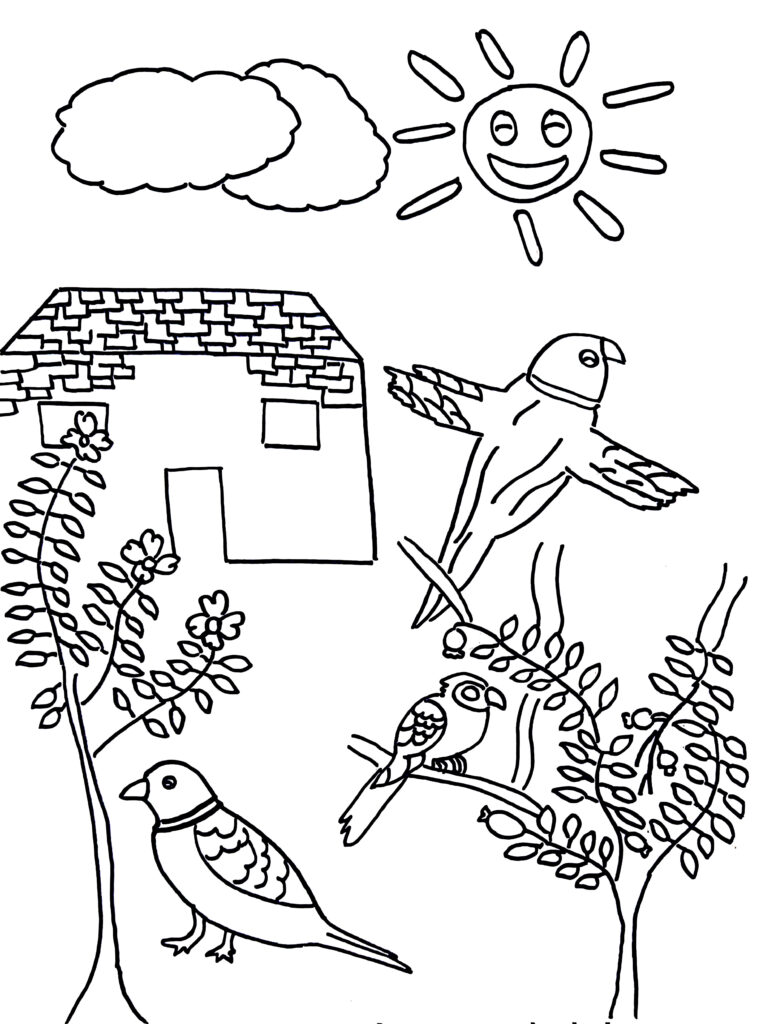
Birds coloring pages - Parrots near a guava tree.
Facts about Parrot
1. What is the native location of parrots?
Parrots are located in tropical and subtropical regions. These regions include Australia, South America, Central America, Southeast Asia, and Africa.
2. What is the lifespan of a parrot?
A parrot’s life span depends on its species, ranging from 10 years to 80 years. Small parrot species, like Budgies, live 10 to 15 years, while large species, like Macaws and African gray parrots can live for about 80 years or more.
3. What are the characteristics of parrots?
Parrots are very intelligent birds, they are social and many species can mimic sounds. They have tough, curved beaks, which help them to break seeds and fruits. Parrots have two feet with two toes pointing front and two toes pointing back, a feature called zygodactyl feet, which is useful for climbing. They are able to understand human language and can solve puzzles.
4. How parrots mimic sound?
Parrots do not have vocal cords, unlike humans. Instead, they have a specialized organ called the syrinx. This hollow, Y-shaped structure situated at the base of the windpipe (trachea), plays a role in mimicking sounds.
5. Do you know about the pigment present in parrot feathers?
Psittacofulvin is the pigment that is responsible for their red, yellow, and orange colors. The pigment prevents keratin degradation by bacteria and ultimately creates a barrier to feather degradation.
References
https://study.com/academy/lesson/parrot-species-lifespan-facts.html
https://en.wikipedia.org/wiki/Psittacofulvin
To download PDF click here – Facts about Parrot
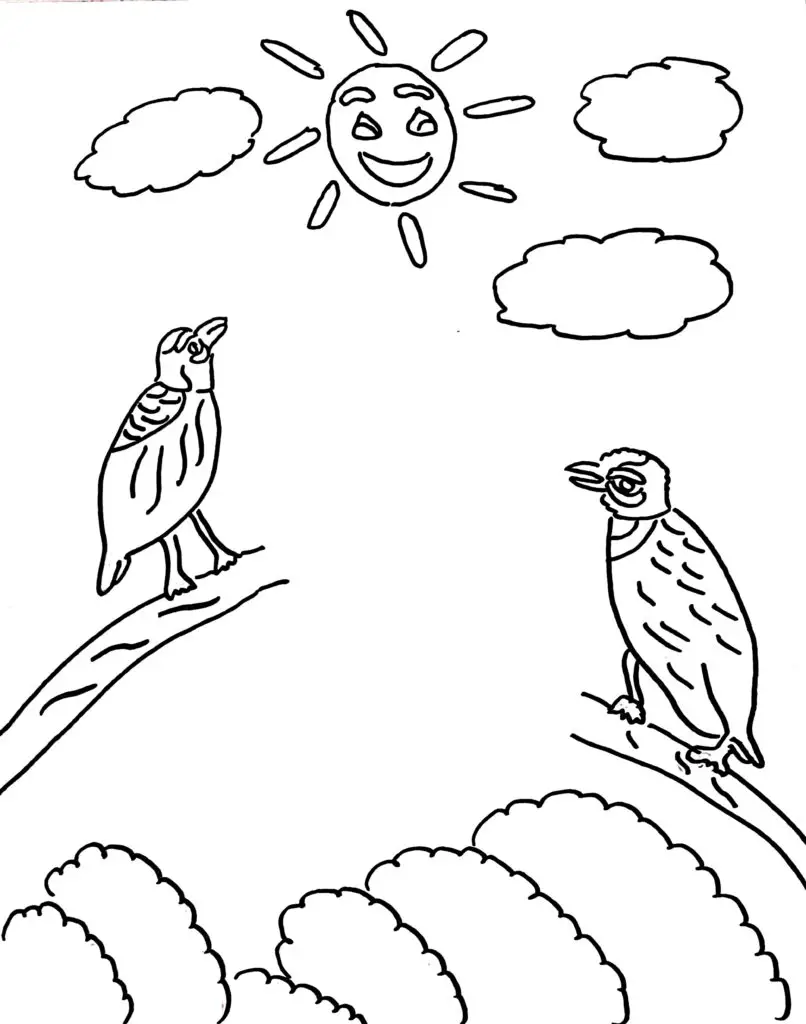
Birds coloring pages- Coppersmith barbet sitting on the stem
Interesting facts about birds (About Coppersmith Barbet)
1. Why is the bird named Coppersmith barbet?
This bird’s sound has a similarity with a coppersmith beating metal, so it is named Coppersmith barbet.
2. What are the other names for the Coppersmith barbet?
The Coppersmith barbet is known by different names in various languages, which include Basanta and Tuktukiya in Hindi, Tambat in Marathi, Chembukotti in Malayalam, Semmarpur-kukkuvaan in Tamil, and Crimson-breasted barbet in English.
3. How many subspecies of Coppersmith barbet are there?
There are nine subspecies of Coppersmith barbet. These include Psilopogon haemacephalus indicus, Psilopogon haemacephalus Roseus, Psilopogon haemacephalus intermedia, Psilopogon haemacephalus haemacephalus, Psilopogon haemacephalus delicus, Psilopogon haemacephalus celestinoi, Psilopogon haemacephalus mindanensis, Psilopogon haemacephalus homochroa, and Psilopogon haemacephalus cebuensis, which are distributed to different geographical locations.
4. Is the Coppersmith barbet the official bird of a specific city?
The Coppersmith barbet is the official bird of Mumbai, India, and was selected in 2011, because it is routinely found there and represents the city’s spirit.
5. How do Coppersmith barbets make their nests?
Coppersmith Barbets make their nests by creating holes in trees with their beaks. Both the male and female participate in the creation of the nests. Because of their ability to create holes in tree wood, they are sometimes called woodpeckers.
6. What are the native places of the Coppersmith barbet?
The Coppersmith barbet is native to the Indian subcontinent and some parts of Southeast Asia. It is found in countries which include, India, Nepal, Bhutan, Bangladesh, Sri Lanka, Myanmar, China, Malaysia, Thailand, Cambodia, Singapore, Vietnam and Indonesia.
References
https://en.wikipedia.org/wiki/Coppersmith_barbet
https://timesofindia.indiatimes.com/city/mumbai/coppersmith-barbet-voted-bird-of-mumbai/articleshow/7589915.cms
Coppersmith Barbet
Interesting facts about birds (About Coppersmith Barbet)
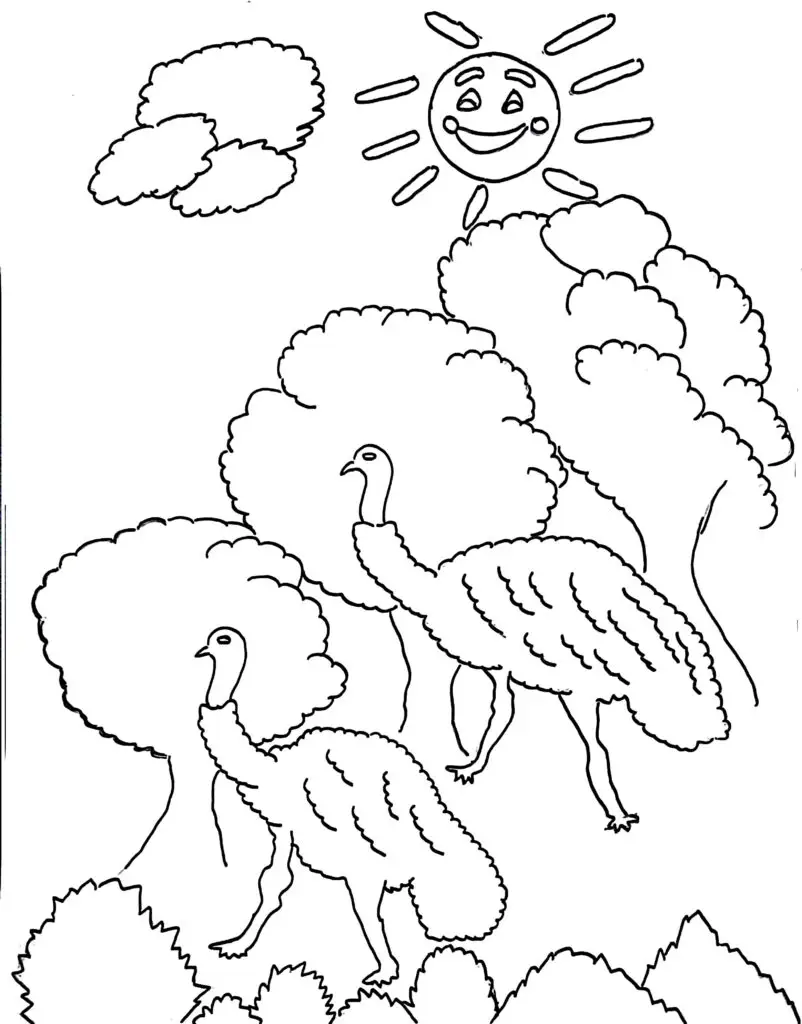
Bird coloring pages -Emu birds
Facts about emus
1.What are the characteristic features of an emu?
The emu is ranked second among the tallest birds in the world after the ostrich. An emu’s height can reach up to 6 feet (1.8 meters), and its length can extend up to 5 feet. They have well-developed calf muscles. Their feet have only three toes, which help them while running. They can run at a speed of up to 30 mph. They have a strong body and long legs. Both males and females have brownish-colored bodies with dark grey heads. Although they have short wings, they are unable to fly.
2. Do you know the lifespan of an emu?
Emu lifespans vary according to their environment. In the wild, their lifespan is about 10–20 years, while under proper care conditions, they can live up to 30–35 years.
3. Why is an emu the national bird of Australia?
The emu can walk only in the forward direction, which indicates the forward-looking nature of Australians. They are found only in Australia. They also have cultural significance, as they appear on the coat of arms, have mythological importance, and also appear on coins and logos. Hence, they are the unofficial national bird of Australia.
4. What is the scientific name of an emu?
Dromaius novaehollandiae is the scientific name for an emu.
References
https://www.britannica.com/animal/emu
https://www.treehugger.com/emu-facts-5075359
https://kids.britannica.com/scholars/article/emu/32569
To download PDF click here- Facts about emus
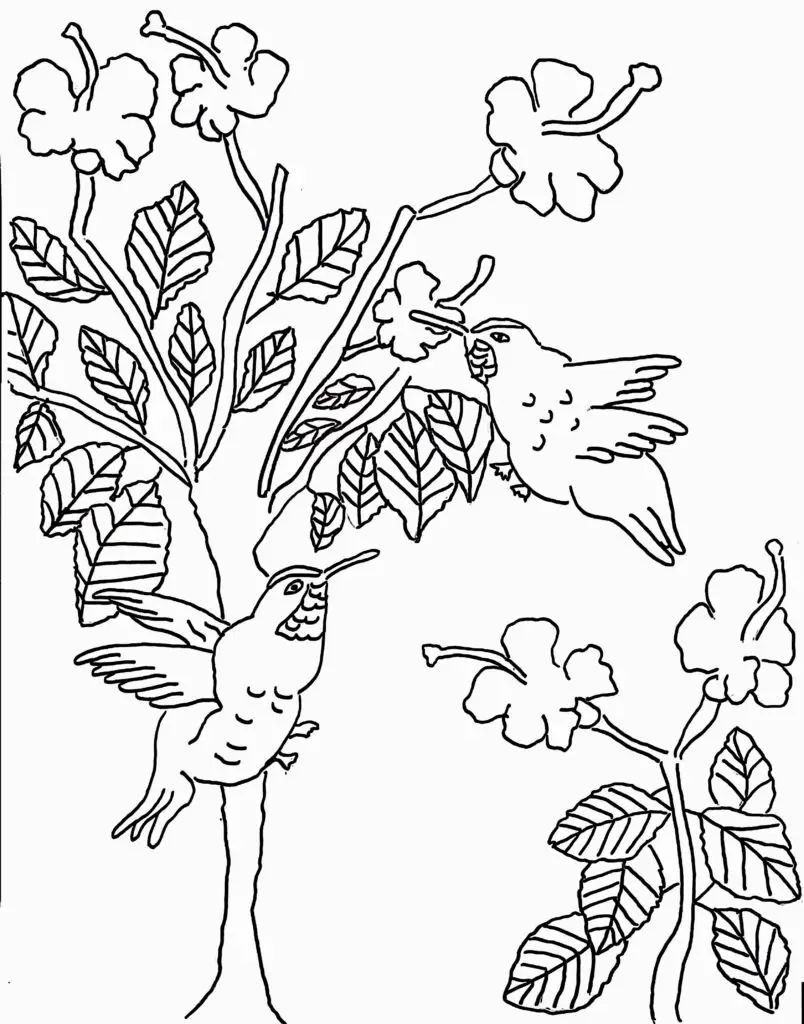
Birds coloring pages - Hummingbirds
Interesting facts about hummingbirds
1. Why is it named hummingbird?
The name hummingbird is derived from the humming sound produced by its fast-beating wings.
2. What are the characteristics of a hummingbird?
They appear in color just like gemstones. They are one of the smallest birds in the world. They need to eat repeatedly as they move their wings very fast. Their weight is less than a nickel. There is a patch on the throat of a hummingbird. They have a high metabolic rate. They generally eat nectar from various flowers and insects to fulfill their energy requirements. Some species are able to fly continuously long distances for migration. They have a long bill. The nest is just the size of a tiny cup and made of plant materials, cobwebs, and moss.
3. Do you know the native location of the hummingbirds?
They are native exclusively to the Americas, with most species being native to Central and South America.
4.What is the biological family of hummingbirds?
There are approximately 320 to 370 species of hummingbird that belong to a single biological family called Trochilidae.
5. Of which country is the hummingbird the national symbol?
The red-billed streamer-tail, also called the doctor bird, is the national symbol of Jamaica. They are part of the Caribbean culture and art. They are seen on the coat of arms of Trinidad and Tobago. They also appear on Jamaican coins and art. Trininad and Tobago are also known as the Land of Hummingbirds.
6. What is unique about hummingbirds?
They have the incredible potential to hover in any direction like a helicopter: frontside, reverse, sideways, and upside down. Their wings beat about 80 times per second. Their heart rate is about 1260 times per minute. They are able to remember information in their minds, such as the feeder, flower, and time to refill the flower with the nector. Their legs are not well-developed enough to walk properly.
7. What is the average life of a hummingbird?
Most species have an average life of about 3–5 years, while some can live up to 10–12 years.
References
https://www.britannica.com/animal/hummingbird
https://en.wikipedia.org/wiki/Hummingbird
https://en.wikipedia.org/wiki/Coat_of_arms_of_Trinidad_and_Tobago
To download PDF click here-
Interesting facts about hummingbirds
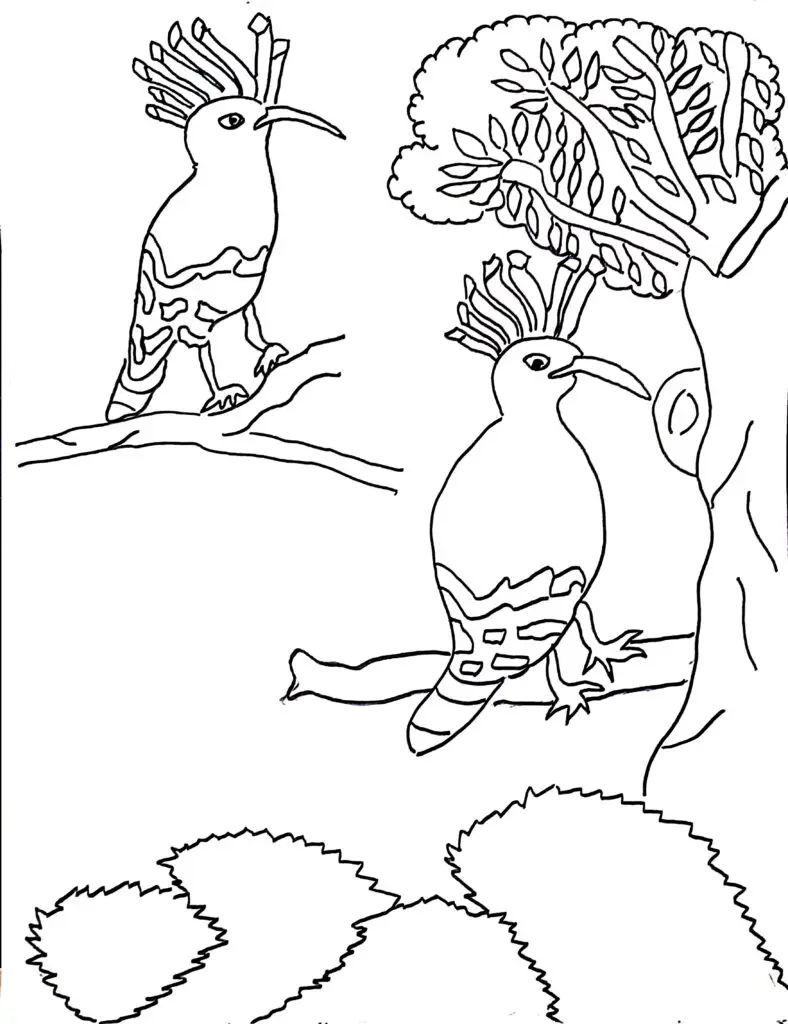
Birds coloring pages - Hoopoe birds
Interesting facts about birds (Some fact about the hoopoe)
1. How many species are there of hoopoes?
There are three species of hoopoes that are found in distinct parts of the world. These include the African hoopoe, the Eurasian hoopoe, and the Madagascar hoopoe.
The African hoopoe: The average size of the African hoopoe varies from 25 to 29 cm, and weight varies from 38 to 67 g. The wingspan varies from 44 to 48 cm. Their crest is chestnut-colored. Coloration varies between males and females; males are chestnut, while the females are grey. In both males and females, there are black and white stripes on the wing. They have a long, narrow, and somewhat down-curved bill. They are found in countries such as South Africa, Namibia, Zimbabwe, Zambia, Malawi, Tanzania, Lesotho, Mozambique, Eswatini, Angola, Kenya, and the Democratic Republic of Congo.
The Eurasian hoopoe: The average size varies from 25 to 32 cm, and the weight varies from 46 to 89 gm. They have a wingspan of 44 to 48 cm. These are cinnamon-colored birds that have black and white wings with a tall crest. They have long and tapering bills. They are mainly found in Europe, Asia, and Africa. There are eight subspecies of Eurasian hoopoe.
The Madagascar hoopoe: These have a size of about 32 cm, and weight varies from 57 to 91 g. They have brown-cinnamon-colored plumage. They have a long and decurved bill. These are found exclusively in Madagascar.
2. Do you know what’s unique about hoopoes?
The hoopoe has several unique features. These include a crest, defensive secretion, butterfly-like flight, and a fan-like crown, as well as their nest. They have a crown, which consists of a crest of feathers. The crown can be raised or flattened, indicating the hoopoe’s mood. Their long wingspan and flight resemble that of a giant butterfly. They are habitual sunbathers, spreading their wings and tail on the ground. A foul-smelling chemical substance is produced by the female hoopoes’ preen glands and applied to feathers and eggs to protect them from predators. They build their nest in tree hollows, cliffs, and walls.
3. Why was it named the hoopoe?
The hoopoe bird’s name is obtained from the distictive oop-oop-oop or hoo-hoo-hoo sound it creates.
4. Is the hoopoe bird featured on postage stamps of any country?
Yes, the hoopoe bird is featured on postage stamps of Germany, Estonia, Gibraltar, Sharjah, Hungary, and Guinea-Bissau.
References
https://en.wikipedia.org/wiki/Hoopoe.
https://www.britannica.com/animal/hoopoe
https://en.wikipedia.org/wiki/Eurasian_hoopoe
https://en.wikipedia.org/wiki/Madagascar_hoopoe
To download PDF click here – Interesting facts about birds (Some facts about the hoopoe)
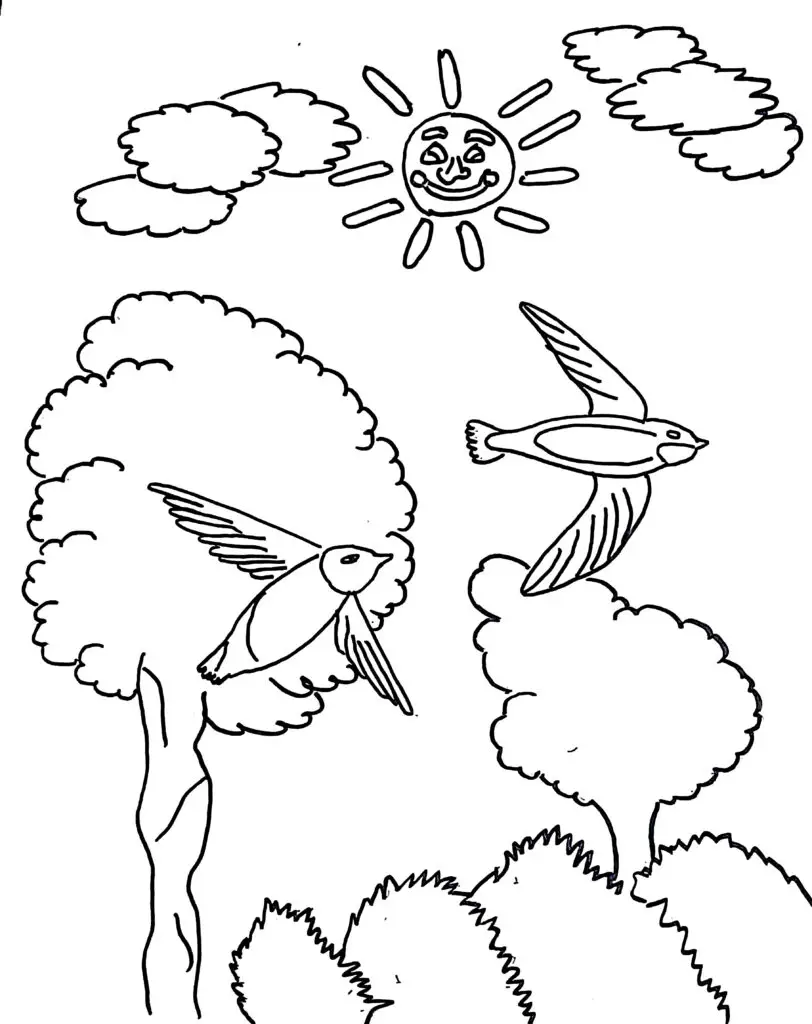
Bird coloring pages- White-throated needletail
White-throated needletail bird
1. What are the characteristics of the white-throated needletail bird?
The white-throated needletail has long and arched wings and a white-colored U-shaped patch on its throat, while the remaining body has a dark, brown-green coloration. The body looks like a cigar with a stubby tail. Their flanks have a distinctive horseshoe-shaped mark. They have small and square-shaped tails with needle-like spines, which is why they are called white-throated needletail birds. They belong to the genus Hirundapus. They are able to fly at speeds of up to 170 km per hour.
2. Where are white-throated needletail birds found?
They are found in Siberia, Mongolia, China, Korea, Japan, and the Himalayan foothills. In the cold season, they relocate to Australia, Southeast Asia, New Zealand, and the Indian subcontinent. They are found in distinct habitats such as forests, grasslands, and savannas.
3. What is the average lifespan of a white-throated needletail bird?
They have an average lifespan of about 5 to 8 years.
4. What are the unique characteristics of the white-throated needletail birds?
The white-throated needletail is one of the quickest birds, and is able to fly at a speed of about 170 km per hour. They live most of their lifespan in the air, and they eat insects, flies, bees, and moths as well as drink water in the air. At the time of migration, they fly from high altitude. They build their nests in tree hollows and cliff cracks.
5. What are the benefits of the white-throated needletail birds to humans?
The white-throated needletail bird plays a crucial role in the maintenance of the ecosystem. They act as pest-controlling agents as they eat various insects in the air, such as beetles, flies, bees, moths, termites, locusts, and grasshoppers. Their appearance is the signal of a healthy and balanced environment.
References
https://en.wikipedia.org/wiki/White-throated_needletail
https://www.birdsinbackyards.net/species/Hirundapus-caudacutus
https://birdsoftheworld.org/bow/species/whtnee/cur/introduction
This was incredibly helpful. Thank you!